Contact our team for professional guidance and solutions.
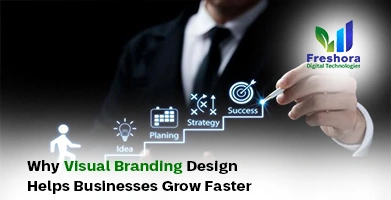
Visual branding influences how customers recognize, understand and remember a business across different touchpoints. It brings together elements such as logos, colours, typography, imagery, layouts and brand-specific visual patterns to create a consistent identity. Research published by the U.S. Small Business Administration highlights that consistent branding helps businesses establish a recognizable presence, while a 2024 Marq survey reported that 68% of businesses said brand consistency had contributed to revenue growth of 10% or more. For growing businesses, visual branding is therefore not simply about appearance; it can become a practical system for communicating value consistently.
Visual Branding for Business Growth helps businesses create a recognizable visual identity that can support:
Brand recognition
Customer trust
Marketing consistency
Professional presentation
Product communication
Customer recall
Long-term brand differentiation
A strong visual branding system connects brand strategy → visual identity → customer touchpoints → consistent communication → measurable growth.
Customers may encounter a business through a website, advertisement, social media post, product package or physical location, and each interaction contributes to their perception of the brand. Visual Branding for Business Growth creates a consistent visual language across these touchpoints so customers can recognize and understand the business more easily. A 2024 Marq survey found that 68% of businesses reported that brand consistency contributed to revenue growth of 10% or more, demonstrating why visual consistency deserves attention as businesses expand.
A logo is only one component of a visual identity.
A complete visual branding system can include:
Logo + Colour System + Typography + Photography + Illustration + Layout + Icons + Graphic Elements + Brand Guidelines
Together, these elements determine how a business looks and feels wherever customers encounter it.
This distinction is important because a memorable brand cannot depend on a logo alone.
A consistent visual identity creates repeated recognition.
Imagine a customer seeing:
A social media advertisement
A website banner
A product package
A business card
If all four use related visual elements, the customer can connect them to the same business.
This creates a simple pattern:
Repeated Visual Cues → Recognition → Familiarity
Businesses often create content across multiple platforms.
Without visual guidelines, each design may look different.
With a defined visual system, teams can work from established rules for:
Colours
Fonts
Logo placement
Image treatment
Layout
Graphic elements
Social media templates
This makes content production more organized.
A business may offer several products or services.
If every marketing asset uses completely different visual styles, customers may struggle to understand whether the communications belong to the same company.
Brand Identity Design for Businesses helps establish a common visual foundation.
For example:
Parent Brand → Service A → Service B → Product C
Each can have its own communication while still remaining connected to the overall brand.
Customers naturally evaluate how professionally a business presents itself.
Visual consistency does not guarantee trust, but it can contribute to a more organized and credible presentation.
Compare:
Random Fonts + Inconsistent Colours + Low-Quality Images
with:
Defined Typography + Consistent Colours + Professional Imagery
The second system creates a more deliberate brand experience.
Many companies compete in similar categories.
A generic visual identity can make a business blend into its market.
Creative Visual Branding Services can help develop distinctive elements through:
Unique colour combinations
Custom graphic patterns
Original illustrations
Distinctive typography
Brand photography
Signature layouts
Industry-relevant visual concepts
Differentiation does not mean being visually complicated. It means being recognizable.
A business can appear on:
Google → Instagram → Website → WhatsApp → YouTube → Email
Customers should ideally experience the same brand across these channels.
Visual branding creates continuity between them.
For example:
Instagram Post
↓
Website
↓
Landing Page
↓
The visual language can remain recognizable throughout the journey.
Products compete heavily through visual presentation.
Branding can determine:
Packaging appearance
Product photography style
Catalogue layouts
Promotional graphics
Website product pages
Advertisement visuals
This allows customers to associate particular visual characteristics with the product range.
Social media is one of the most visible areas of a modern brand.
Without a visual system, a social profile can become a collection of unrelated designs.
A stronger approach creates:
Brand Template → Content Category → Visual Variation
For example:
One recognizable design structure.
A different but related structure.
A consistent testimonial format.
A repeatable product presentation.
The feed becomes a recognizable brand environment rather than a collection of individual posts.
Recognition and recall are different.
A customer may recognize a brand when they see it but still fail to remember it later.
Repeated visual cues can support memory.
This is why businesses should avoid constantly changing their:
Logo treatment
Colours
Typography
Photography style
Graphic language
A stable identity gives the market more opportunities to associate those elements with the business.
Premium positioning is not created simply by using expensive-looking colours or minimalist designs.
It depends on consistency and attention to detail.
A premium visual system may involve:
Carefully selected typography
High-quality photography
Controlled spacing
Consistent layouts
Refined colour usage
Purposeful packaging
The objective is to make every customer touchpoint feel intentional.
Marketing campaigns often run across several platforms.
Without a consistent identity, customers may see one advertisement and later encounter another without realizing both belong to the same campaign.
A visual branding system can connect:
Campaign Concept + Brand Identity + Platform Creative
This creates continuity while allowing campaign-specific creativity.
As a business grows, more people become involved in communication.
Marketing teams, salespeople, designers, agencies and external vendors may all create brand materials.
Without clear visual rules, inconsistency becomes more likely.
A brand guideline can provide a common reference for everyone.
This makes the identity more scalable.
Instead of designing every marketing asset from zero, businesses can create reusable components.
Logo, fonts and colours.
Social templates, banners and promotional layouts.
Presentation slides, brochures and business documents.
Website sections, advertisements and landing-page visuals.
This turns branding into an operating system for visual communication.
Brand identity should not stop at digital platforms.
The same system can extend to:
Business cards
Brochures
Packaging
Signboards
Office branding
Uniforms
Product labels
Event materials
Sales presentations
This creates an integrated brand experience.
Content marketing becomes easier when the brand already has a visual language.
For example:
Blog → Featured Image
Video → Thumbnail
Social Post → Branded Template
Infographic → Defined Visual Style
Advertisement → Campaign Layout
This reduces the need to reinvent the visual direction for every piece of content.
A practical way to evaluate branding is the Visual Brand Ladder.
Can customers identify the business?
Does the business look the same across major channels?
Does the visual identity stand apart from competitors?
Does the visual style communicate the brand's personality and values?
Can new products, campaigns and platforms adopt the identity without breaking consistency?
This creates a progression:
Recognize → Consistent → Differentiate → Connect → Scale
Businesses can use this framework to identify where their current visual identity needs improvement.
|
Basic Graphic Design |
Strategic Visual Branding |
|
Focuses on individual designs |
Focuses on the complete identity |
|
Creates individual assets |
Creates reusable systems |
|
May vary from project to project |
Maintains visual consistency |
|
Short-term communication |
Long-term brand recognition |
|
Design-focused |
Brand and business-focused |
|
One campaign or asset |
Multiple customer touchpoints |
This is why Business Branding Design Solutions should go beyond creating attractive individual graphics.
Visual branding becomes particularly important when a business:
Launches a new company
Rebrands an existing business
Expands into new markets
Introduces new products
Builds a professional website
Starts social media marketing
Begins paid advertising
Has inconsistent marketing materials
Wants to compete with established brands
Needs a scalable design system
Freshora Digital Technologies can approach visual branding as a complete business communication system rather than a single logo-design project.
Understand the business, audience, positioning and communication goals.
Define the visual personality, design language and brand characteristics.
Create or refine the logo, colour system, typography and supporting visual elements.
Develop templates and rules for social media, websites, advertisements and marketing materials.
Apply the identity across the business's digital touchpoints.
Use the established system when creating new campaigns, content and promotional assets.
The workflow becomes:
Brand Discovery → Visual Direction → Identity → Design System → Digital Application → Consistent Growth
A business may need a visual branding review when:
Different platforms use unrelated designs.
Marketing materials use too many fonts.
Colours change frequently.
The logo is used inconsistently.
Social media posts lack a recognizable style.
Product packaging looks disconnected from advertising.
The website does not visually match offline materials.
Different teams create completely different designs.
Customers remember the product but not the company.
The brand looks similar to several competitors.
It is the strategic use of visual identity elements to create recognition, consistency and differentiation across a business's customer touchpoints.
No. A logo is one element of visual branding. A complete identity can include colours, typography, photography, layouts, icons, graphics and brand guidelines.
It can give a small business a more consistent and recognizable presentation across websites, social media, advertising, packaging and offline materials.
Consistency helps customers connect different communications with the same business and can make marketing execution more organized.
Professional and consistent presentation can contribute to perceived credibility, although trust also depends on factors such as product quality, customer service and reputation.
There is no fixed period. A major change is usually more appropriate when business positioning, target audience, products or market direction changes substantially.
They can include visual identity development, brand guidelines, typography, colour systems, graphic elements, templates and implementation across marketing channels.
Visual Branding for Business Growth is broader than logo design.
A 2024 Marq survey reported that 68% of businesses said brand consistency contributed to revenue growth of 10% or more.
Consistent visual elements can help customers recognize a business across multiple touchpoints.
A strong visual identity can support differentiation in competitive markets.
Brand systems make marketing production more scalable.
Visual branding can connect digital and offline customer experiences.
Product packaging, photography, social media and websites can all follow the same visual language.
The Visual Brand Ladder provides a practical framework for evaluating recognition, consistency, differentiation, connection and scalability.
Strong branding should support business strategy rather than follow visual trends blindly.
The best visual identity is distinctive enough to be remembered and flexible enough to grow with the business.
Visual Branding for Business Growth gives businesses a structured way to become recognizable, consistent and differentiated across the many places customers encounter them. From websites and social media to packaging, advertisements and physical materials, a unified visual identity can make communication more coherent while providing a scalable foundation for future marketing. The Marq finding that 68% of businesses associated brand consistency with revenue growth of 10% or more further highlights why consistency deserves strategic attention.
The strongest approach is to build branding as a system rather than a collection of individual designs: Brand Discovery → Visual Direction → Identity → Design System → Digital Application → Consistent Growth. When visual branding is aligned with business positioning and applied consistently, it becomes a long-term communication asset that can support recognition, customer connection and sustainable brand development.



Summary: In Trichy’s bustling healthcare market, a well-crafted flyer is more than just paper... Read More
Blog SummaryA business card is more than a piece of contact information; it is a tangible extension... Read More

Summary: Product packaging design plays a vital role in bakery brand success by driving customer att... Read More
Our expert will call you shortly to understand your needs and help grow your business.
Get exclusive digital marketing tips, SEO insights, web & app updates, and job opportunities delivered straight to your inbox.
Join our WhatsApp channel for instant digital marketing tips, SEO insights, web & app updates, and latest job opportunities.
Join NowFreshora Digital Technologies proudly serves businesses across Tiruchirappalli (Trichy), including Cantonment, Puthur, Thillai Nagar, Palakarai, Subramaniyapuram, Mela Chinthamani, Woraiyur, KK Nagar, Karumandapam, Crawford, Edamalaipatti Pudur (EMP), Kattur, Airport Area, Ariyamangalam, Panjappur, Thuvakudi, Tiruverumbur, BHEL Township, Srirangam, Thiruvanaikaval, Samayapuram, No.1 Tollgate, Central Bus Stand Area, and Chathiram Bus Stand Area.
We also serve clients across Tamil Nadu, India, and globally in Singapore, the UAE, Saudi Arabia, Canada, Australia, the United Kingdom, and the United States, delivering innovative Website Development, Mobile App Development, Software Development, SEO, Google Business Profile Management, and Digital Marketing solutions that help businesses grow and succeed in the digital world.


