
Contact our team for professional guidance and solutions.
A business website in Dubai is developed through a series of stages rather than being created and published in a single step. A clear website development process in Dubai normally begins with understanding the business and its users, followed by planning, design, development, testing and launch.
Dubai projects can also involve requirements that influence the process from the beginning, such as Arabic and English content, RTL layouts, mobile-first experiences, AED pricing, UAE payment methods, local contact preferences and .ae domain considerations.
Understanding these stages helps businesses prepare content, make decisions on time and reduce avoidable changes before launch.
Most website projects follow a similar sequence, although the exact workflow depends on the website's size, functionality and content requirements.
The first stage is understanding what the website needs to achieve.
This includes identifying the target audience, business objectives, products or services, required pages, functionality, competitors and existing digital assets.
For an existing website, the initial review may also consider current URLs, useful content, analytics, backlinks and technical problems before the new structure is planned.
Dubai businesses may need to identify requirements such as:
Arabic and English content
RTL support
WhatsApp or local contact options
enquiry and quotation forms
booking functionality
customer accounts
payment functionality
CRM or third-party integrations
Defining these requirements early helps prevent major changes during development.
The next stage is deciding how information will be organised.
This includes the sitemap, navigation, page hierarchy, URLs and important customer journeys.
A service-based business might have a structure such as:
Home → Services → Individual Service Pages → About → Areas Served → Blog → Contact
An e-commerce website would require a different structure involving categories, products, filters, cart and checkout.
Content should also be prepared during this stage. Headings, service information, images, FAQs, contact details and calls to action should be planned before development wherever possible.
Separating structure from visual design allows navigation and information problems to be addressed before detailed interface work begins.
Once the structure is established, the user experience and visual layout can be designed.
Wireframes can show how information will be arranged before final visual elements are introduced. The design stage then establishes typography, spacing, colours, navigation, forms, buttons and other interface components.
For Dubai websites serving Arabic-speaking audiences, Arabic and English requirements should be considered during design rather than added later. Arabic uses a right-to-left reading direction, which can affect navigation, forms, alignment, menus and other interface elements.
Mobile layouts should also be considered from the beginning. A website should remain usable across common mobile, tablet and desktop screen sizes.
After the design is approved, developers convert the planned layouts into a functioning website.
Depending on the project, development may include frontend interfaces, backend functionality, CMS configuration, databases, forms, APIs and third-party integrations.
The technology used should be based on the actual requirements rather than selected only because it is popular.
For websites serving Dubai customers, payment and currency requirements may also need to be considered. Where payments are required, the selected payment provider, supported methods, transaction requirements and AED handling should be confirmed before implementation.
There is no single website development timeline that applies to every Dubai project.
The schedule can be affected by:
Number of pages
Content readiness
Design complexity
Number of languages
Custom functionality
Third-party integrations
E-commerce requirements
Design revisions
Client approval speed
Testing requirements
A simple website may be completed within several weeks, while a larger website with custom functionality can take considerably longer. Current Dubai development companies commonly describe workflows ranging from a few weeks for straightforward websites to substantially longer schedules for complex projects.
A practical planning sequence is:
Stage |
Typical planning period |
|
Discovery and requirements |
2–4 days |
|
Sitemap and content planning |
2–5 days |
|
UX and visual design |
5–10 days |
|
Development |
10–20 days |
|
Testing and revisions |
3–5 days |
|
Launch preparation |
1–2 days |
These are planning estimates, not guaranteed delivery periods.
A website intended for the Dubai market may require several local considerations during development.
If both languages are required, the language structure and RTL requirements should be defined before development. Arabic pages should be tested using actual Arabic content because text length, typography and direction can affect the interface.
For Dubai businesses, prices and transactions may need to be displayed in AED. Payment requirements should be confirmed during planning instead of being treated as a final-stage addition.
.ae is the official top-level domain for the UAE. Businesses choosing a .ae domain should use an accredited registrar and ensure the registration details are accurate.
Websites that collect customer information should consider the privacy and data-handling requirements applicable to their operations. UAE Federal Decree-Law No. 45 of 2021 provides a framework for personal data protection and includes obligations relating to the processing and protection of personal information.
Testing should take place before the website becomes publicly available.
Important checks include:
Mobile, tablet and desktop layouts
Major browsers
Navigation and internal links
Contact and enquiry forms
Images and media
WhatsApp and click-to-call links
Login or account functions
Payment workflows where applicable
Page speed and performance
Metadata and indexability
SSL and security configuration
Analytics and tracking
Redirects for changed URLs
For bilingual websites, Arabic and English pages should be tested separately. RTL issues can appear in menus, buttons, forms, breadcrumbs and mobile layouts even when the English version works correctly.
The website launch process in Dubai begins when the final website is moved from its development or staging environment to the production environment.
The technical launch normally includes:
Uploading the final website and database
Connecting the production domain
Configuring DNS
Confirming SSL
Checking redirects
Reviewing robots.txt and sitemap settings
Confirming analytics and tracking
Testing important pages and forms
Checking mobile usability
Reviewing indexing settings
The .ae domain process should also be checked if a UAE country-code domain is being used. The UAE Government identifies .ae as the official UAE country-code domain and directs businesses to accredited registrars for registration.
Launching the website is not the end of the development lifecycle.
The first days and weeks after launch should be used to identify unexpected errors, broken links, form problems, performance issues or indexing problems.
Analytics and search-related data can also help identify how visitors interact with the new website. If the project involved an existing website migration, changed URLs and redirects should receive particular attention.
A controlled launch followed by monitoring can reduce the risk of unnoticed technical problems affecting visitors.
Before considering the project complete, check:
Website structure is approved
Content is complete
Arabic and English requirements are handled where needed
Mobile layouts work correctly
Forms have been tested
Payment functions work where applicable
SSL is active
Domain settings are correct
Redirects are working
Sitemap and robots.txt are configured
Analytics is recording data
Important pages are indexable
Backups are available
The website development workflow in Dubai is therefore a sequence of connected decisions rather than a single development task. Discovery establishes the requirements, structure organises the information, design creates the user experience, development builds the functionality, testing identifies problems and the launch process moves the finished website into production.
Planning Dubai-specific requirements such as Arabic and English content, AED transactions, .ae domains, mobile usability and applicable data-handling considerations early in the project can make the overall process more predictable and reduce avoidable changes later.

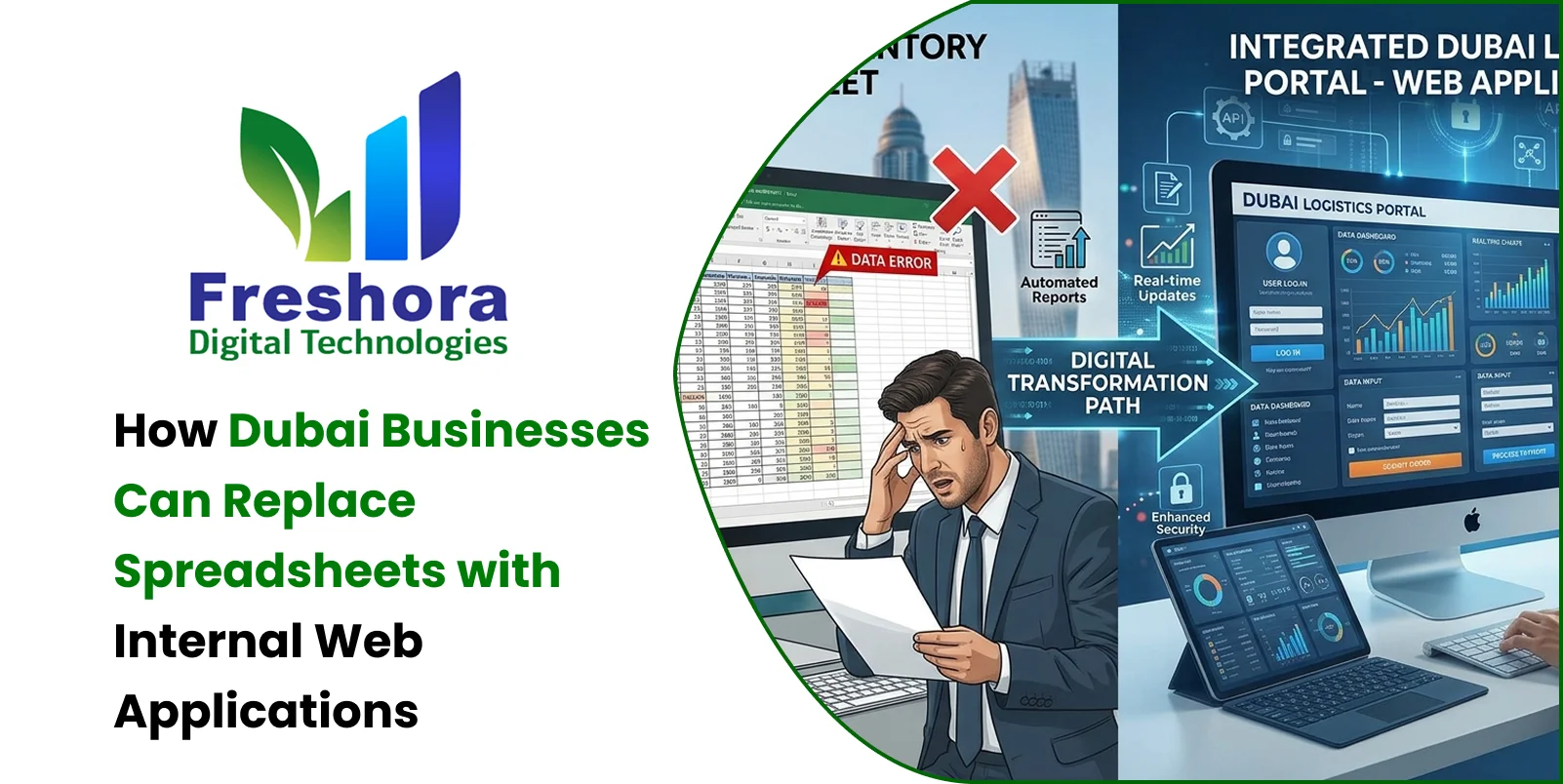
Quick Answer Dubai businesses can replace spreadsheets with internal web applications when shared f... Read More
Quick Answer A Dubai business needs a web application instead of a standard website when customers,... Read More

Quick Answer E-commerce integration connects an online store with the business systems that manage... Read More
Our expert will call you shortly to understand your needs and help grow your business.
Get exclusive digital marketing tips, SEO insights, web & app updates, and job opportunities delivered straight to your inbox.
Join our WhatsApp channel for instant digital marketing tips, SEO insights, web & app updates, and latest job opportunities.
Join NowFreshora Digital Technologies proudly serves businesses across Dubai, including Downtown Dubai, Business Bay, Dubai Marina, Jumeirah, Jumeirah Lake Towers (JLT), Jumeirah Village Circle (JVC), Jumeirah Village Triangle (JVT), Palm Jumeirah, Dubai Internet City, Dubai Media City, Dubai Silicon Oasis, Dubai International Financial Centre (DIFC), Dubai Design District (d3), Dubai Healthcare City, Dubai Knowledge Park, Dubai Sports City, Motor City, Arabian Ranches, Al Barsha, Barsha Heights (TECOM), Emirates Hills, The Springs, The Meadows, The Greens, Mirdif, Deira, Bur Dubai, Al Karama, Al Qusais, Al Nahda, Al Rigga, Oud Metha, Umm Suqeim, Al Safa, Al Wasl, City Walk, Dubai Hills Estate, Dubai South, Dubai Investment Park (DIP), Jebel Ali, Jebel Ali Free Zone (JAFZA), Ras Al Khor Industrial Area, Al Quoz Industrial Area, Dubai Industrial City, International City, Dubai Festival City, Dubai Creek Harbour, Nad Al Sheba, Academic City, Bluewaters Island, The World Islands, Expo City Dubai, Dubai Airport Free Zone (DAFZA), and Dubai Airport.
We also serve businesses across the United Arab Emirates, including Abu Dhabi, Sharjah, Ajman, Umm Al Quwain, Ras Al Khaimah, and Fujairah. Our services extend across the GCC region, including Saudi Arabia, Qatar, Kuwait, Bahrain, and Oman, as well as international markets such as India, Singapore, Canada, Australia, the United Kingdom, and the United States. Freshora Digital Technologies provides Website Development, Mobile App Development, Software Development, SEO, Google Business Profile Management, Digital Marketing, UI/UX Design, E-commerce Development, AI Solutions, and other digital technology services tailored to different industries and business requirements. We help businesses strengthen their online visibility, generate qualified enquiries, improve customer engagement, and support sustainable digital growth.

