Real Estate & Property
Property listings, location filters, project details and enquiry routing.

A clear, fast and useful website built around your business goals
Your website is often the first place a potential customer checks before contacting your business. It should explain what you do, answer the questions that matter and make the next step easy.
Freshora Digital Technologies provides website development services in Dubai for businesses that need a dependable digital presence, from corporate websites and online stores to tailored customer journeys. As a website development agency in Dubai, we bring planning, interface design, development, technical SEO and conversion paths into one coordinated process.
We start with the job the website needs to do: generate qualified enquiries, support sales, explain a complex service, or connect customers with your team. We then recommend a suitable platform and features, including Arabic-English content, mobile-first layouts, WhatsApp enquiries, payment options or CRM connections where they serve a clear purpose.
Our Dubai branch gives local businesses a direct point of contact. We work with you from the first requirements discussion through design reviews, development, quality checks, launch and agreed post-launch support.
A property company, distributor in Jebel Ali or Dubai Investment Park, professional services firm in Business Bay and retail business serving customers across the UAE do not need the same website. Their buyers ask different questions, check different details and take different routes to an enquiry or purchase.
We define the audience, priority services, key actions and information people need before deciding on layouts or technology. That keeps the build tied to a clear outcome instead of adding features that increase cost without improving the customer journey.
The right platform depends on who will maintain the website, how often content changes, which systems need to connect and how the business may grow. We explain those trade-offs before development so you can make an informed decision about a CMS, e-commerce platform or custom build. For budgeting, our guide to website development cost in Dubai explains the factors that shape the project investment.
Our website design and development work covers the sitemap, page templates, responsive interface, content placement, forms, integrations, testing and launch checks. The agreed scope makes clear what is included and what may require a separate phase.
A website should make it easier for people to understand a business, evaluate what it offers and take the next step with confidence. That starts well before the first page is designed. We begin by understanding what the business needs the website to accomplish and what customers need to find, understand or do when they arrive.
In Dubai, a site may serve local buyers, international clients, residents and business decision-makers, sometimes across more than one language. Clear service information, practical contact options and reliable connections between website enquiries and internal teams can make that journey easier. Our guide to digital transformation for businesses in Dubai explores the wider role connected digital processes can play.
We move from discovery to structure, design and refinement, with decisions reviewed at the appropriate stage. You know what the website is intended to achieve, which features are in scope and what needs approval before the next stage begins.
What does the website need to achieve?
We review your business model, priority audiences, main services, existing website and the questions potential customers ask before they enquire or buy.
The outcome is a defined purpose and a practical set of requirements for the build.
What should customers see, understand and do?
We map the sitemap, navigation, service pages, supporting content and calls to action so visitors can find important information without unnecessary steps.
It also helps keep content focused and reduces avoidable changes later in the project.
How should the planned experience work in practice?
We develop the approved layouts and functionality with responsive behaviour, forms, content presentation, accessibility basics and performance in mind.
Customers should be able to read, navigate and contact your business comfortably across common screen sizes.
What could prevent someone from using the website confidently?
We check forms, links, menus, mobile layouts, key templates, integrations and contact journeys. Where tracking is configured, we also verify that the agreed analytics events are firing correctly.
We prioritise fixes that affect usability, accuracy, functionality or launch readiness rather than adding features for their own sake.
The most useful website is not necessarily the one with the most features. It is the one that makes the right information easier to find, communicates the business clearly and supports the actions that matter to the organisation.
For some businesses, that may mean generating qualified enquiries. For others, it could mean explaining a complex service, helping customers compare options, accepting bookings, selling products or connecting website activity with internal systems.
We therefore treat technology as a means to achieve the business objective, rather than allowing the technology itself to determine what the website should become.
Dubai businesses work across sectors such as property, hospitality, retail, logistics, professional services and technology. The UAE Digital Economy Strategy targets increasing the digital economy’s contribution to GDP from 9.7% in 2022 to 19.4% within ten years. For a business website, this direction reinforces the value of clear digital services, useful customer journeys and systems that can work together.
A useful website answers three questions quickly: what do you offer, is it relevant to me, and how can I take the next step? When those answers are buried under vague headings or long navigation paths, interested visitors may leave before contacting you.
A Dubai-based buyer may want a quick quotation, a property client may need to browse listings, and a B2B prospect may need to verify capabilities before contacting your team. We shape page content and calls to action around those different needs rather than forcing every visitor down one path.
We place service details, proof points, FAQs and contact options where they help people make a decision. For suitable projects, we also connect enquiry forms with CRM or communication tools so the business can respond without re-entering information manually.
This gives your team a website that communicates clearly today and has a structure that can be maintained as services and customer needs change.

For established Dubai businesses, the website often acts as the first detailed introduction to the company for customers, partners and procurement teams.
We organise company information, service capabilities, sector expertise, case studies, certifications, locations and enquiry options into a clear structure that helps visitors assess the business. Where appropriate, we can also support careers, investor information and downloadable company profiles.
We plan templates and navigation so new service lines, resources, projects or language versions can be added without creating a disconnected collection of pages.
Our e-commerce development work connects product discovery with checkout, payment, fulfilment and order management. For UAE stores, we consider local payment methods, delivery rules, currencies and Arabic content where the business needs them.
We scope the store around your catalogue size, stock process, delivery model, payment provider and who will manage orders after launch.
Custom website development in Dubai is useful when a business needs functionality that standard themes and plugins cannot support cleanly. For straightforward requirements, a well-configured content management system can be easier and more economical to maintain; we recommend a bespoke build when the business process genuinely calls for it.
A bespoke build may be appropriate for a property portal with specialised filters, a quotation tool based on several variables, a booking flow with branch-specific availability, or a website that needs to share data with CRM, inventory or ERP software. We first map the process, then decide whether custom code is justified.
We can model the steps your customer or team follows, including conditional paths, approvals, calculations and status updates, instead of forcing the process into a generic template.
Bring relevant information into role-specific views so authorised users can track requests, manage records or review activity without navigating unrelated sections.
Route enquiries and relevant customer details into existing systems where supported, reducing manual copying and helping teams follow up consistently.
Use suitable APIs to exchange data with payment services, inventory tools, logistics systems or other approved platforms, subject to access and provider capabilities.
Model availability, service areas, staff, time slots and price rules when a standard booking tool cannot represent the real operating process.
Give customers access to relevant requests, documents, quotations, bookings or progress updates in one account area.
Use conditional fields and business rules to collect the right information and calculate outputs such as estimates or eligibility where appropriate.
Apply permissions by user role or department so sensitive records and administrative actions are available only to authorised people.
If your main requirements are company information, service pages, a blog and enquiry forms, a CMS such as WordPress may be the sensible choice. It gives your team a familiar way to update content without paying to custom-build routine features.
We recommend custom development when standard tools create recurring workarounds, cannot enforce necessary business rules or leave important systems disconnected. This is also where a separate custom software development solution may be more appropriate than extending a public-facing website.
We choose the simplest approach that can meet the requirement reliably. That keeps the initial build manageable and makes future maintenance, training and development easier to plan.
Search visibility is influenced by the way a website is structured as well as by the quality of its content. Page hierarchy, crawlable navigation, metadata, internal links and performance should be considered while the site is being planned, not left until after launch.
We build the technical foundations into the agreed scope and coordinate page structure with the content and SEO requirements you provide or commission.
For a Dubai audience, we build local relevance through accurate contact details, our branch address, clearly defined service coverage and content that answers the needs of customers in the market.
Customers may arrive through traditional search results, map listings, voice queries or answer interfaces. Clear explanations and consistent business information help people understand your services wherever they discover them.
We can organise content using answer engine optimisation (AEO) and generative engine optimisation (GEO) principles, with direct answers, logical headings, consistent business information and relevant structured data.
Our focus is on useful information, sound technical implementation and consistent business details, giving search engines and answer interfaces a clearer foundation for interpreting the website.
For businesses serving Arabic and English-speaking customers, translating words is only one part of the work. We plan Arabic and English website structures around right-to-left layout, navigation, content parity and language-specific metadata.
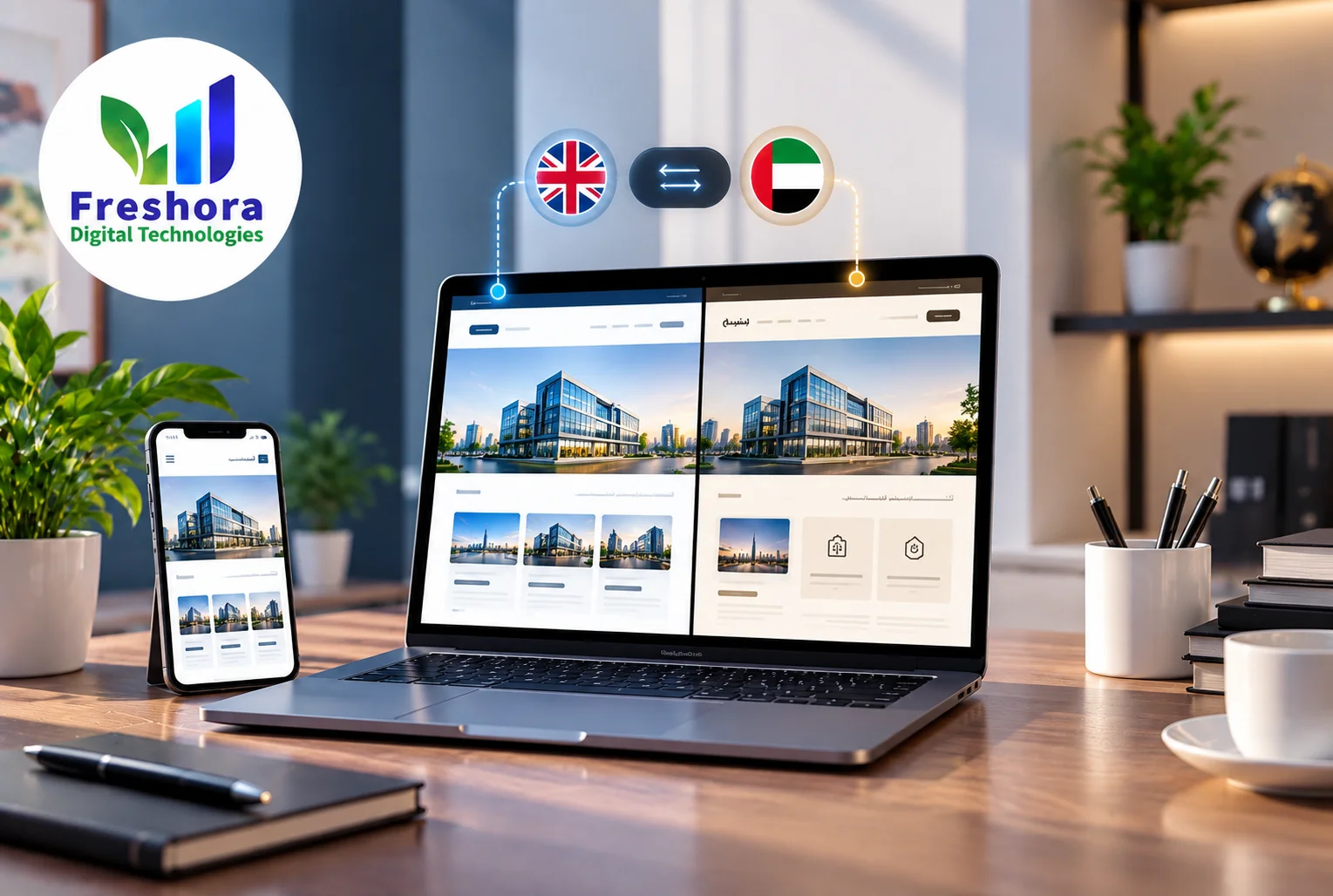
Customers may discover a business while commuting, visiting a retail area or checking options between meetings. We make sure that navigation, service details, forms and click-to-call options remain usable across mobile, tablet and desktop screens.
A visitor should be able to understand the business and take the next step without struggling with the website.
A website for a property portfolio has different needs from a hotel, trading company or professional services firm. We shape page structure, content and functionality around the questions each audience needs answered.
Property listings, location filters, project details and enquiry routing.
Project portfolios, capability statements, certifications and quotation requests.
Specialities, practitioner profiles, treatment information and appointment requests.
Menus, locations, booking options, delivery links and promotions.
Room or package details, facilities, booking journeys and destination information.
Packages, itineraries, availability, enquiry forms and booking workflows.
Service scopes, sectors served, location coverage and quote requests.
Programmes, admissions information, course details and enquiry journeys.
Service descriptions, professional credentials, case studies and consultation forms.
Product categories, inventory visibility, payments and customer order journeys.
Vehicle or service details, enquiry handling, service bookings and locations.
Service capabilities, shipping information, quote requests and B2B enquiries.
Product ranges, specifications, certifications and distributor enquiries.
Product features, implementation details, integrations and demo requests.
Service information, credentials, disclosures and consultation requests.
Company profiles, capabilities, industry experience and procurement information.
A redesign should improve the website without discarding assets that already support your business. We begin by reviewing the current user journey, content and technical setup, then identify what should be retained, improved, consolidated or rebuilt.
Before recommending a redesign, we review:
The migration plan can cover URL mapping, redirects, title and description updates, canonical tags, internal links, sitemap changes and post-launch checks. These steps help protect valuable page signals and give the team a clear checklist before and after launch.
We organise the project into clear stages, from initial requirements to launch readiness. Each stage has a defined purpose and review point, helping everyone stay aligned on functionality, content, timing and responsibilities.
We confirm the business goal, audiences, priority services, existing assets, technical constraints and success criteria for the new website.
We agree the sitemap, templates, content responsibilities, navigation and calls to action before the full build moves ahead.
We prepare page layouts that reflect your brand and content while considering mobile behaviour, accessibility basics and conversion paths.
We implement the approved pages and functionality, including CMS setup, forms, e-commerce features or integrations included in the scope.
We test key templates, links, forms, responsive layouts, agreed integrations and tracking. After approval, we complete launch checks and handover for the agreed hosting and domain setup.
In Dubai, a business website may need to serve local customers, international buyers, corporate decision-makers and people comparing several service providers before getting in touch. We structure websites around these different needs so visitors can understand your offering, assess its relevance and take the next step without unnecessary friction.
Instead of simply adding Dubai to the page content, we consider how your business operates in the UAE and what potential customers need to know before contacting you. The result is a website planned around real commercial requirements rather than a generic location-based template.
For example, a real estate business may need property information and qualified enquiry forms, while a professional services company may need detailed service pages, project evidence and consultation requests. An online retailer may need product discovery, payment options and a straightforward checkout process. We adapt the website structure to the decisions your customers need to make.
We also consider what happens after someone submits an enquiry. Where required, the website can connect with your CRM or other business systems so enquiries are easier to organise, assign and follow up. This helps align the website with your sales process rather than treating the launch as the final goal.
A successful website project depends on decisions made before development starts: what the site must achieve, which features matter, who supplies the content, how approvals work and what happens after launch. We use those decisions to shape the delivery plan instead of starting with a one-size-fits-all package.
We make the work easier to assess by discussing deliverables, integrations, content responsibilities, handover and maintenance needs at the start. For examples of how we approach different business requirements, explore our website and digital project case studies . This is particularly useful when a project involves multiple stakeholders, an existing website or connections to business systems.
We bring this approach to businesses across Dubai and the UAE, supported by our local branch in DIP 2. Our experience spans different industries, project requirements and international markets.
Businesses that trust Freshora to support their digital requirements.
Projects delivered across different business needs and requirements.
Experience working with businesses across varied industries.
Skilled professionals contributing to our digital delivery capabilities.
Clients served across international markets.
Digital solutions delivered to businesses across multiple cities.
We can cover requirements planning, sitemap and page structure, UI/UX design, responsive development, CMS setup, agreed integrations, technical SEO foundations, testing and launch support. We define the actual deliverables around your project before development begins.
We consider who will update the content, the number and type of pages, e-commerce requirements, integrations and plans for growth. A CMS may suit a content-led website, while an online store platform or custom development may be better for more specialised requirements.
Yes. We can plan bilingual experiences with Arabic right-to-left and English left-to-right layouts, including navigation, page structure and language-specific metadata according to your requirements.
Where the chosen providers support the required connections, we can scope payment gateway, CRM, WhatsApp and other API integrations. We confirm provider access, transaction flows and third-party requirements before development.
Whether you are launching a new business site, improving an existing website or building an online store for customers in Dubai and the wider UAE, we start by understanding your audience, services and practical business goals.
Our Dubai branch gives you a local point of contact for discussing the sitemap, functionality, integrations and technical approach. We keep the agreed scope visible through development and can arrange support for the next stage after launch.
Get exclusive digital marketing tips, SEO insights, web & app updates, and job opportunities delivered straight to your inbox.
Join our WhatsApp channel for instant digital marketing tips, SEO insights, web & app updates, and latest job opportunities.
Join NowFreshora Digital Technologies proudly serves businesses across Dubai, including Downtown Dubai, Business Bay, Dubai Marina, Jumeirah, Jumeirah Lake Towers (JLT), Jumeirah Village Circle (JVC), Jumeirah Village Triangle (JVT), Palm Jumeirah, Dubai Internet City, Dubai Media City, Dubai Silicon Oasis, Dubai International Financial Centre (DIFC), Dubai Design District (d3), Dubai Healthcare City, Dubai Knowledge Park, Dubai Sports City, Motor City, Arabian Ranches, Al Barsha, Barsha Heights (TECOM), Emirates Hills, The Springs, The Meadows, The Greens, Mirdif, Deira, Bur Dubai, Al Karama, Al Qusais, Al Nahda, Al Rigga, Oud Metha, Umm Suqeim, Al Safa, Al Wasl, City Walk, Dubai Hills Estate, Dubai South, Dubai Investment Park (DIP), Jebel Ali, Jebel Ali Free Zone (JAFZA), Ras Al Khor Industrial Area, Al Quoz Industrial Area, Dubai Industrial City, International City, Dubai Festival City, Dubai Creek Harbour, Nad Al Sheba, Academic City, Bluewaters Island, The World Islands, Expo City Dubai, Dubai Airport Free Zone (DAFZA), and Dubai Airport.
We also serve businesses across the United Arab Emirates, including Abu Dhabi, Sharjah, Ajman, Umm Al Quwain, Ras Al Khaimah, and Fujairah. Our services extend across the GCC region, including Saudi Arabia, Qatar, Kuwait, Bahrain, and Oman, as well as international markets such as India, Singapore, Canada, Australia, the United Kingdom, and the United States. Freshora Digital Technologies provides Website Development, Mobile App Development, Software Development, SEO, Google Business Profile Management, Digital Marketing, UI/UX Design, E-commerce Development, AI Solutions, and other digital technology services tailored to different industries and business requirements. We help businesses strengthen their online visibility, generate qualified enquiries, improve customer engagement, and support sustainable digital growth.

