
Contact our team for professional guidance and solutions.
For many mobile applications, the payment experience is one of the most important parts of the customer journey.
A user may discover a product, create an account, select a service and reach checkout within minutes. If the payment process is complicated, slow or unreliable, the business can lose the transaction at the final stage.
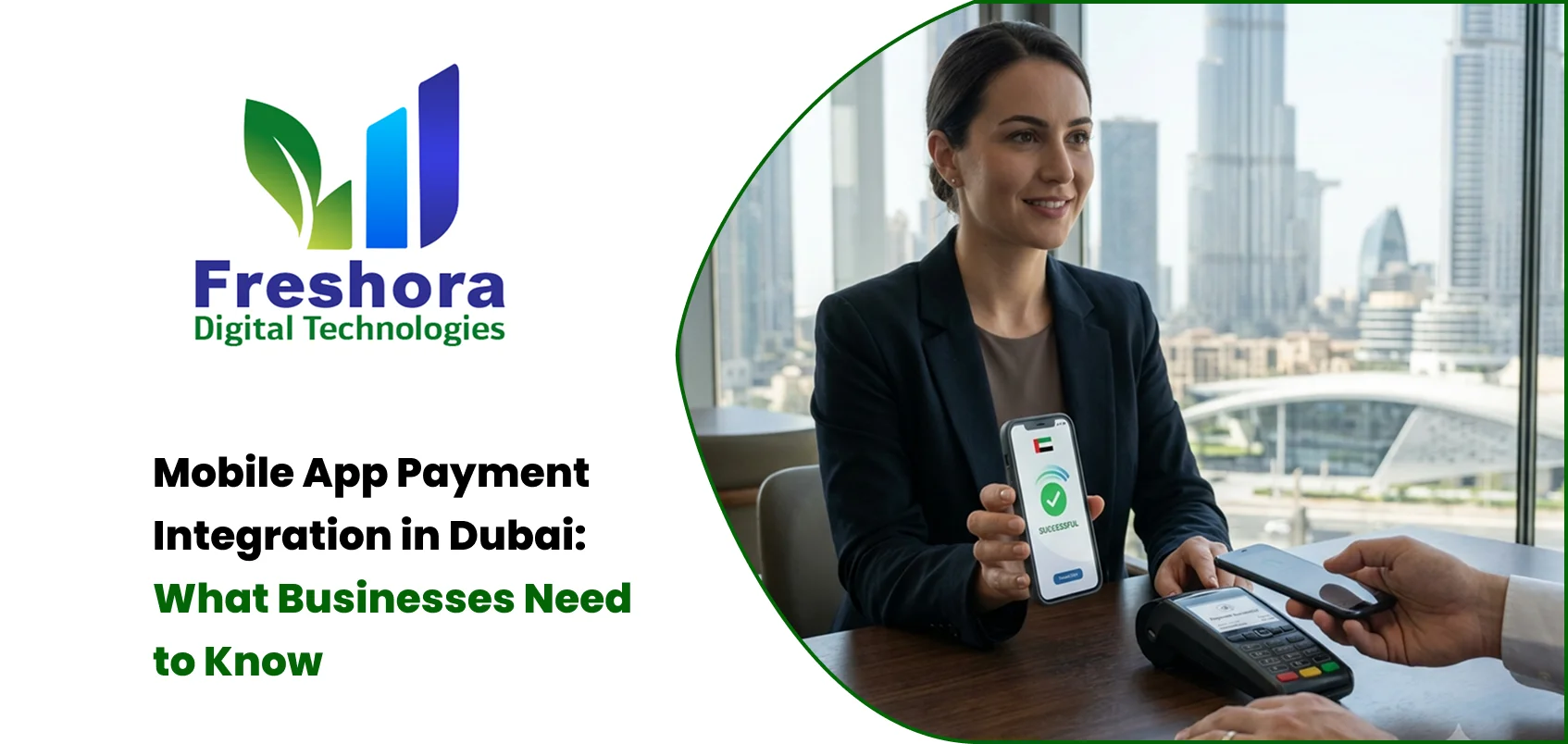
This makes mobile app payment integration in Dubai an important consideration for e-commerce businesses, food delivery platforms, booking applications, marketplaces, subscription services and other digital businesses.
The UAE has also been investing heavily in digital payment infrastructure. The Central Bank of the UAE reported that the country's Instant Payment Instruction system processed 33.8 million transactions worth AED 168.8 billion during 2025. The UAE's national instant payment platform Aani had also exceeded 12.5 million registered users by April 2026.
These developments show why businesses should think carefully about payment architecture when building mobile applications for the UAE.
Mobile payment integration connects an application to a payment infrastructure that allows customers to complete transactions from within the app.
Depending on the business model, this may involve:
Debit and credit cards
Digital wallets
Bank-based payment methods
Payment gateways
Instant payment services
In-app purchases
Subscription billing
Saved payment methods
The exact combination depends on the type of application and its customers.
Dubai is a highly digital market with businesses operating across retail, hospitality, travel, food, real estate and professional services.
A customer may already be comfortable using digital payments in other parts of their daily life. A mobile application that introduces unnecessary payment friction can therefore create a poor experience.
A good checkout should be:
Simple
Fast
Clear
Secure
Mobile-friendly
Transparent about charges
Easy to recover if payment fails
A payment gateway acts as an important part of the transaction process between the application, payment provider and financial institutions.
When choosing a Dubai app payment gateway, businesses should evaluate:
Check whether the gateway supports the payment methods your customers actually use.
If the business operates in Dubai, AED support may be important. International businesses may also need multiple currencies.
Developers should check whether the provider offers suitable APIs or mobile SDKs for the application's technology stack.
Payment information must be handled securely.
Businesses should understand how refunds, cancellations and partial refunds are processed.
Subscription businesses need appropriate recurring-payment capabilities.
Finance and operations teams may require transaction reports and reconciliation features.
The UAE has developed several national payment systems.
The Central Bank of the UAE lists systems including the UAE Payment Gateway System, UAE Funds Transfer System, UAE Direct Debit System and UAE National Card Switch.
Aani is another important development in the country's instant-payment environment.
According to Al Etihad Payments, Aani surpassed 12.5 million registered users in April 2026 and supports instant transfers in as little as three seconds.
For businesses, this means payment planning should consider the broader UAE payment environment rather than relying on one generic payment method.
Payment integration is not only a technical task.
The interface also affects conversion.
A mobile checkout should clearly show:
Product or service
Quantity
Price
Taxes or additional charges where applicable
Delivery fees where applicable
Total amount
Selected payment method
Confirmation status
Avoid unnecessary form fields.
If the application already knows the customer's address or account details, avoid asking for the same information repeatedly.
Payment failures will happen.
The important thing is how the application handles them.
Instead of showing a generic message such as:
"Payment failed."
provide useful information.
For example:
"We couldn't complete the payment. Please check your card details or try another payment method."
The user should also have a clear way to retry.
The application should avoid creating duplicate orders if a customer taps the payment button multiple times.
After a successful payment, the user should immediately understand what happened.
A good confirmation screen may include:
Confirmation message
Order number
Amount paid
Date
Payment method
Next step
Receipt or invoice option
For bookings or service applications, the confirmation should also explain what happens next.
Payment security should not be treated as an optional feature.
Businesses should work with reputable payment providers and follow appropriate security practices.
Applications should avoid storing sensitive payment information unnecessarily.
Where supported, businesses can use tokenisation or payment-provider mechanisms so sensitive payment information does not need to be directly handled by the application backend.
Authentication and transaction controls should also be considered for higher-risk actions.
The UAE Personal Data Protection Law provides a framework for protecting personal data and establishes obligations around processing and protecting personal information.
A payment-enabled application may process information such as:
Name
Phone number
Address
Transaction information
Account information
Device information
Businesses should understand what information is collected, why it is collected, where it is processed and how it is protected.
Before launching, payment functionality should be tested thoroughly.
Important scenarios include:
Successful payment
Failed payment
Cancelled payment
Expired card
Incorrect card details
Network interruption
Duplicate button taps
Refund
Partial refund
Payment timeout
Order created but payment failed
Payment succeeded but confirmation was delayed
The development team should also verify that transactions are correctly reflected in the business backend.
Payment should connect smoothly with the rest of the application.
For example:
Product → Cart → Address → Payment → Confirmation → Order tracking
A problem between any of these stages can affect the customer experience.
For a booking application:
Service → Date → Customer details → Payment → Booking confirmation
The architecture should make these states clear and reliable.
Mobile app payment integration in Dubai requires a combination of technology, user experience, security and local market understanding.
The UAE's rapidly developing payment infrastructure creates opportunities for businesses to make mobile transactions faster and more convenient. But the payment experience should be planned around the application's business model and customer journey.
A professional [mobile application development process] can help businesses plan payment architecture, API integration, security, checkout UX and transaction testing as part of the overall product.


Quick Answer Mobile Web Design focuses on creating websites that are easy to navigate, read, and us... Read More

Completing mobile app development is only one part of launching a digital product. Before customers... Read More

Building a mobile application is a significant business decision. The biggest mistakes often happen... Read More
Our expert will call you shortly to understand your needs and help grow your business.
Get exclusive digital marketing tips, SEO insights, web & app updates, and job opportunities delivered straight to your inbox.
Join our WhatsApp channel for instant digital marketing tips, SEO insights, web & app updates, and latest job opportunities.
Join NowFreshora Digital Technologies proudly serves businesses across Dubai, including Downtown Dubai, Business Bay, Dubai Marina, Jumeirah, Jumeirah Lake Towers (JLT), Jumeirah Village Circle (JVC), Jumeirah Village Triangle (JVT), Palm Jumeirah, Dubai Internet City, Dubai Media City, Dubai Silicon Oasis, Dubai International Financial Centre (DIFC), Dubai Design District (d3), Dubai Healthcare City, Dubai Knowledge Park, Dubai Sports City, Motor City, Arabian Ranches, Al Barsha, Barsha Heights (TECOM), Emirates Hills, The Springs, The Meadows, The Greens, Mirdif, Deira, Bur Dubai, Al Karama, Al Qusais, Al Nahda, Al Rigga, Oud Metha, Umm Suqeim, Al Safa, Al Wasl, City Walk, Dubai Hills Estate, Dubai South, Dubai Investment Park (DIP), Jebel Ali, Jebel Ali Free Zone (JAFZA), Ras Al Khor Industrial Area, Al Quoz Industrial Area, Dubai Industrial City, International City, Dubai Festival City, Dubai Creek Harbour, Nad Al Sheba, Academic City, Bluewaters Island, The World Islands, Expo City Dubai, Dubai Airport Free Zone (DAFZA), and Dubai Airport.
We also serve businesses across the United Arab Emirates, including Abu Dhabi, Sharjah, Ajman, Umm Al Quwain, Ras Al Khaimah, and Fujairah. Our services extend across the GCC region, including Saudi Arabia, Qatar, Kuwait, Bahrain, and Oman, as well as international markets such as India, Singapore, Canada, Australia, the United Kingdom, and the United States. Freshora Digital Technologies provides Website Development, Mobile App Development, Software Development, SEO, Google Business Profile Management, Digital Marketing, UI/UX Design, E-commerce Development, AI Solutions, and other digital technology services tailored to different industries and business requirements. We help businesses strengthen their online visibility, generate qualified enquiries, improve customer engagement, and support sustainable digital growth.

