

Contact our team for professional guidance and solutions.
Building a mobile application is a significant business decision.
The biggest mistakes often happen before developers write the first line of code.
A business may start development with a general idea such as "we need an app" without clearly defining the target audience, business model, features, integrations, budget or success criteria.
That can lead to changing requirements, development delays and unnecessary costs.
For businesses planning a mobile app project in Dubai, structured planning can make the development process much more predictable.
The first question should not be:
"What features should the app have?"
It should be:
"What problem will the application solve?"
For example:
A restaurant may want an app to increase direct orders.
A real estate company may want an app to simplify property discovery.
A service company may need an application for bookings and customer management.
An e-commerce business may want to increase repeat purchases.
The application should be designed around the business objective.
A mobile application should have a clearly defined audience.
For a Dubai business, the audience may include:
Local customers
UAE residents
International visitors
Expatriate professionals
Business customers
Students
Families
Specific industry groups
Understanding the audience influences language, UX, features and marketing.
Dubai's official language is Arabic, while English is widely used.
Businesses serving broad audiences should consider whether Arabic and English support is appropriate.
If Arabic is required, RTL support should be included in the project requirements from the beginning.
Adding Arabic and English RTL after the interface has already been designed can require additional design and development work.
Before development begins, create a list of required features.
For example, an e-commerce application might need:
Registration
Login
Product search
Categories
Product details
Cart
Checkout
Payment
Order tracking
Notifications
Customer support
A service-booking app might require:
Service listing
Availability
Booking
Location
Payment
Notifications
Booking history
Separate features into three categories:
Required for the initial release.
Useful but potentially suitable for a later release.
Ideas that can be considered after the application gains users.
This helps prevent an unnecessarily large first version.
MVP means Minimum Viable Product.
It is the smallest practical version of the application that can deliver the core business value.
For example, an online marketplace does not necessarily need advanced recommendation algorithms on day one.
The first version may focus on:
User registration
Product listings
Search
Cart
Payment
Orders
Once customers start using the application, the business can use real feedback to decide what to build next.
Before designing screens, map how users will move through the application.
For example:
Download → Register → Browse → Select → Checkout → Payment → Confirmation
Every major journey should be mapped.
Other journeys may include:
Login → Forgot Password → OTP → New Password
or:
Search → Filter → Product → Add to Cart → Checkout
User-flow mapping helps identify missing screens and unnecessary steps.
Once requirements are clear, the design stage can begin.
This usually includes:
Wireframes
User flows
Interface design
Design system
Prototypes
Responsive considerations
Accessibility
The objective is to create a consistent experience rather than simply make individual screens look attractive.
Technology decisions depend on the application.
Businesses may consider:
Native Android
Native iOS
Cross-platform development
Backend technologies
Cloud infrastructure
Database
APIs
The right choice depends on:
Performance requirements
Budget
Time
Features
Maintenance
Team expertise
Future scalability
There is no single technology stack that is best for every Dubai business.
Many applications require external integrations.
These may include:
Payment gateways
Maps
SMS
Push notifications
ERP
Analytics
Social login
Cloud storage
These integrations should be identified during planning.
Otherwise, a required integration may appear unexpectedly during development and cause delays.
Security requirements should also be documented before development.
Think about:
Authentication
User roles
Permissions
Data encryption
API security
Secure storage
Account recovery
Data retention
Audit logs
The requirements will differ depending on the type of application.
A healthcare or financial application will naturally have different security requirements from a basic content application.
Mobile app development costs depend on many variables.
The budget can be affected by:
Number of platforms
Number of features
UI complexity
Backend requirements
Payment integration
Third-party APIs
Admin panel
Security requirements
Testing
Maintenance
Instead of asking only for the price of "an app," businesses should first define the scope.
A clear scope makes quotations more meaningful.
A typical project may be divided into stages:
Discovery
Requirements
UX planning
UI design
Development
API integration
Testing
Security review
Deployment
Maintenance
The exact timeline depends on project complexity.
Testing should not be postponed until the final week.
Test plans should cover:
Functional testing
UI testing
Device testing
Performance
Network conditions
Payment flows
Security
Notifications
App permissions
Language versions
If the app supports Arabic and English, both versions should be tested independently.
A development project should include a launch plan.
Consider:
App Store account
Google Play account
App icon
Screenshots
Descriptions
Privacy policy
Data disclosures
Support information
App review requirements
Analytics
Crash monitoring
Apple and Google both require developers to provide important information about apps before distribution.
The project does not end when the application reaches the stores.
After launch, businesses may need:
Bug fixes
Security updates
OS compatibility updates
Feature improvements
Performance optimisation
Analytics review
User feedback analysis
A maintenance plan should therefore be included in the original business strategy.
Good mobile app project planning reduces uncertainty.
For a Dubai business, planning should cover the target market, languages, user journeys, features, integrations, technology, security, budget, testing and launch requirements.
The goal is not to document every possible feature before development.
The goal is to understand what the application needs to accomplish and create a realistic roadmap to get there.
Once the requirements are clear, a professional mobile app development team in Dubai can translate the business idea into UX, technology architecture and a practical development plan.

Quick Answer Mobile Web Design focuses on creating websites that are easy to navigate, read, and us... Read More
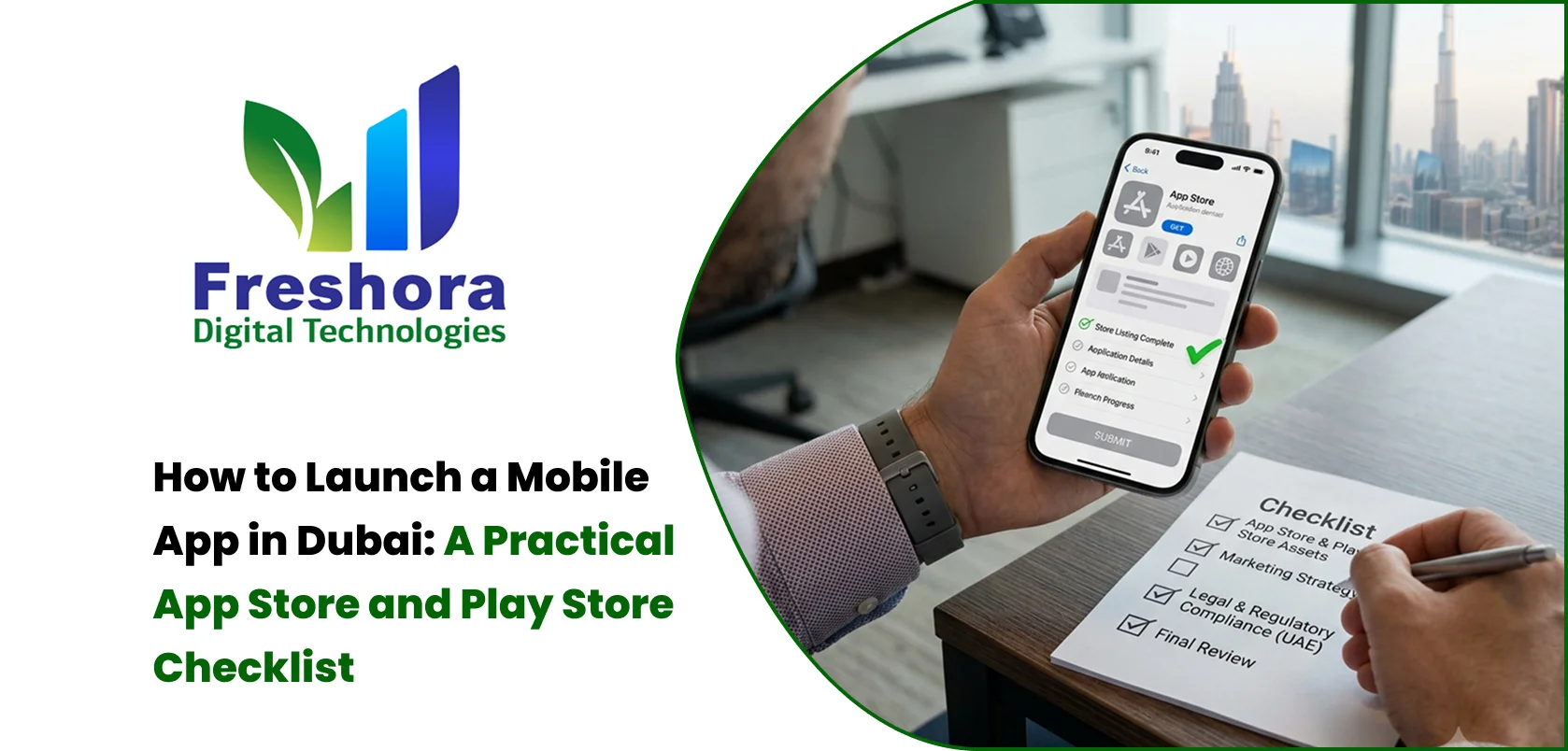
Completing mobile app development is only one part of launching a digital product. Before customers... Read More

A mobile application can collect valuable customer information, from names and contact details to ad... Read More
Our expert will call you shortly to understand your needs and help grow your business.
Get exclusive digital marketing tips, SEO insights, web & app updates, and job opportunities delivered straight to your inbox.
Join our WhatsApp channel for instant digital marketing tips, SEO insights, web & app updates, and latest job opportunities.
Join NowFreshora Digital Technologies proudly serves businesses across Dubai, including Downtown Dubai, Business Bay, Dubai Marina, Jumeirah, Jumeirah Lake Towers (JLT), Jumeirah Village Circle (JVC), Jumeirah Village Triangle (JVT), Palm Jumeirah, Dubai Internet City, Dubai Media City, Dubai Silicon Oasis, Dubai International Financial Centre (DIFC), Dubai Design District (d3), Dubai Healthcare City, Dubai Knowledge Park, Dubai Sports City, Motor City, Arabian Ranches, Al Barsha, Barsha Heights (TECOM), Emirates Hills, The Springs, The Meadows, The Greens, Mirdif, Deira, Bur Dubai, Al Karama, Al Qusais, Al Nahda, Al Rigga, Oud Metha, Umm Suqeim, Al Safa, Al Wasl, City Walk, Dubai Hills Estate, Dubai South, Dubai Investment Park (DIP), Jebel Ali, Jebel Ali Free Zone (JAFZA), Ras Al Khor Industrial Area, Al Quoz Industrial Area, Dubai Industrial City, International City, Dubai Festival City, Dubai Creek Harbour, Nad Al Sheba, Academic City, Bluewaters Island, The World Islands, Expo City Dubai, Dubai Airport Free Zone (DAFZA), and Dubai Airport.
We also serve businesses across the United Arab Emirates, including Abu Dhabi, Sharjah, Ajman, Umm Al Quwain, Ras Al Khaimah, and Fujairah. Our services extend across the GCC region, including Saudi Arabia, Qatar, Kuwait, Bahrain, and Oman, as well as international markets such as India, Singapore, Canada, Australia, the United Kingdom, and the United States. Freshora Digital Technologies provides Website Development, Mobile App Development, Software Development, SEO, Google Business Profile Management, Digital Marketing, UI/UX Design, E-commerce Development, AI Solutions, and other digital technology services tailored to different industries and business requirements. We help businesses strengthen their online visibility, generate qualified enquiries, improve customer engagement, and support sustainable digital growth.

