Contact our team for professional guidance and solutions.
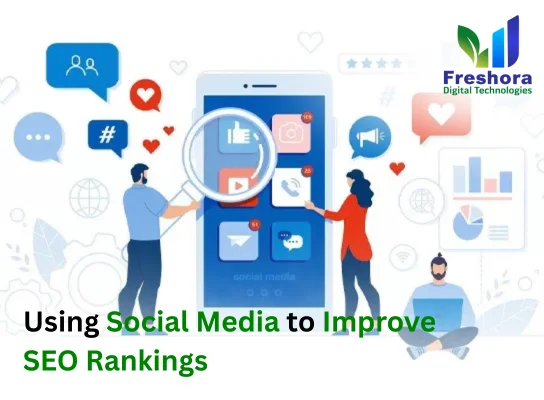
Social media and SEO are often treated as two completely separate marketing activities: one team publishes posts while another works on Google rankings. In reality, they can support the same discovery journey when planned together. Social platforms can expose useful content to new audiences, create conversations around topics, strengthen brand recognition, generate referral visits, and sometimes lead to people discovering the business through search later. The opportunity is not to treat social engagement as a guaranteed Google ranking factor, but to use social media as a distribution and discovery layer around an SEO strategy.
Social Media for SEO Performance works best when social content helps valuable website content reach more people, encourages genuine discussion, creates opportunities for earned mentions, and increases the number of ways people can discover a business.
Social media should therefore support SEO through five connected activities:
Create → Distribute → Discuss → Discover → Reinforce
Google's current Search Console features make this relationship even more measurable. In July 2026, Google introduced platform properties that allow eligible creators and site owners to see how content from Instagram, TikTok, X, and YouTube is discovered through Google Search and Discover.
The biggest misunderstanding is assuming that every social signal directly improves organic rankings.
Likes, shares, followers, and comments should not be treated as a simple ranking-score formula.
Instead, social media can create indirect SEO value by putting useful content in front of people who may:
Visit the website.
Search for the brand later.
Reference the content elsewhere.
Share a resource with their own audience.
Discover another useful page through the website.
Become a customer and eventually provide a review or testimonial.
Google's Search Essentials encourages businesses to tell people about their websites and participate in relevant communities, while Google's ranking systems use many different signals rather than a single social metric.
Your SEO and social strategies may be disconnected if:
Social posts receive attention but send almost no relevant visitors to your website.
Blog articles are published but never promoted through suitable social channels.
Social profiles contain outdated business information.
Different platforms describe the brand differently.
Your team creates social content and SEO content independently.
Popular customer questions on social media never become website content.
Social posts generate conversations that are not converted into useful website resources.
You cannot identify which topics perform well across both search and social channels.
The key warning sign is repeatedly creating content without learning from how audiences respond to it.
Social media can shorten the distance between content creation and audience feedback.
Suppose a business publishes an article about a common customer problem and promotes it on Instagram. The comments may reveal three additional questions that customers care about. Those questions can then become sections in the article, FAQs, short videos, or future resources.
The result is a feedback loop:
Social conversation → customer insight → website content → search opportunity → social distribution
This makes social media useful not simply as a promotional channel, but as a source of real-world information about what an audience wants to understand.
India's social media environment is large enough to make this distribution layer strategically significant. DataReportal's Digital 2026: India report estimates 500 million social media user identities in India in October 2025, representing 34.1% of the country's population. It also reports that social media user identities increased by 9 million, or 1.8%, between late 2024 and the end of 2025.
Platform-level figures also show substantial audiences: DataReportal reports 414 million Instagram users and 491 million YouTube users in India in early 2025 based on platform advertising resources, with the important caveat that advertising reach is not identical to monthly active users.
The SEO implication is straightforward: social platforms provide substantial opportunities to distribute useful information, but businesses should measure whether that exposure contributes to meaningful discovery and customer behaviour rather than assuming reach equals SEO success.
Dropping a website link into a post without explaining why someone should click rarely creates a compelling discovery experience.
Engagement can be useful, but likes alone do not demonstrate search visibility, qualified traffic, or business value.
Each platform has different user behaviour and content formats. Copy-pasting the same caption across every channel can make the strategy less effective.
Artificial followers, comments, and shares create numbers without necessarily creating an interested audience.
There is no reliable formula where a certain number of likes or shares directly produces a higher Google position.
If social traffic reaches a slow, confusing, or poorly structured website, the opportunity created by the social post can disappear.
This article uses a unique Social-to-Search Content Loop:
Search Insight → Core Content → Social Adaptation → Audience Feedback → Website Expansion → Search Refinement
Start with a search or customer problem. Build a strong website resource. Convert its key ideas into platform-specific social content. Study audience questions and reactions. Feed those insights back into the website. Then use Search Console and analytics data to refine the next content cycle.
This turns Social Media SEO Strategies into an ongoing information system rather than a simple posting schedule.
Identify topics already relevant to the business through Search Console, keyword research, customer questions, and existing website content.
Develop the main blog, service page, guide, case study, or resource on your website first. Social content should amplify something valuable rather than replace it.
One useful article could become:
A short educational video.
A carousel explaining the main points.
A customer-question post.
A myth-versus-fact post.
A practical checklist.
A visual statistic.
A short expert explanation.
Do not simply resize the same content. Adapt the idea to the audience behaviour of Instagram, YouTube, LinkedIn, Facebook, or other relevant platforms.
Send people to the most relevant page instead of always linking to the homepage. Google recommends useful, crawlable links and relevant anchor text as part of its Search guidance.
Comments, messages, polls, and recurring questions can reveal content gaps. Turn genuinely useful questions into website resources.
Track social referral traffic, assisted conversions, branded search behaviour, website engagement, and search performance rather than treating each channel as an isolated report.
If one topic consistently performs across social and search, expand the topic intelligently instead of producing unrelated content simply to maintain posting frequency.
A combined SEO-social workflow can use:
Google Search Console for search queries and organic performance.
Google Analytics for referral traffic and conversions.
Social platform analytics for content and audience behaviour.
Keyword research tools for topic discovery.
Content calendars for coordinating website and social publishing.
UTM tracking for identifying campaign-level referral performance.
Social listening and comment analysis for discovering customer questions.
Content audits for identifying website resources worth redistributing.
Google's new Search Console social and video reporting is particularly relevant because it brings social-platform discovery data closer to traditional Search performance analysis.
|
Disconnected Approach |
Integrated Approach |
|
SEO and social teams work separately |
Shared content priorities |
|
Publish a blog and stop |
Distribute and extend the topic |
|
Social posts chase engagement |
Social posts support discovery |
|
Same content on every platform |
Platform-specific adaptations |
|
Likes as the main KPI |
Traffic, discovery and conversions |
|
Ignore comments |
Use questions as content insights |
|
Website receives occasional social links |
Relevant pages become content destinations |
The strongest Social Media Content Optimization strategy begins with the website's most valuable information and then adapts it for people who consume content differently.
For example, a Trichy-based service company could publish a detailed guide on a customer problem, create a short Instagram video explaining one mistake from that guide, publish a LinkedIn post discussing the business impact, and create a YouTube video demonstrating the solution. All formats can point toward the most relevant website resource where appropriate.
This approach also creates a stronger Social Media and Organic Search Visibility relationship because one core idea can appear across multiple discovery environments without publishing duplicate website pages.
For businesses evaluating SEO Services in Trichy, the important question should therefore be: Which social content can strengthen the reach, usefulness, and discoverability of our most valuable website content?
Treating followers as the same thing as SEO authority.
Assuming social engagement automatically improves rankings.
Sending every social visitor to the homepage.
Publishing identical posts across every platform.
Ignoring social comments as customer research.
Creating viral content unrelated to the business.
Buying followers or engagement.
Publishing social content without a clear website destination when a destination would add value.
Measuring reach without checking traffic quality.
Neglecting website speed, mobile usability, and page experience.
Google's guidance stresses that page experience involves multiple aspects, including mobile usability, Core Web Vitals, security, and avoiding intrusive elements.
Identify topics that matter to both customers and the business.
Check existing organic search opportunities.
Create a strong website resource first.
Convert the resource into platform-specific social content.
Use genuine customer questions for future content.
Link to the most relevant website page.
Use UTM tracking where appropriate.
Monitor social referral traffic.
Monitor organic search queries.
Compare content performance across channels.
Refresh website content using audience feedback.
Repeat successful topic patterns without producing repetitive content.
Social media should support SEO, not be presented as a replacement for it.
Likes and followers are not the same as organic search performance.
The strongest connection is created through useful content and audience discovery.
Social conversations can provide valuable first-hand customer insights.
One strong website resource can become multiple platform-specific content assets.
India's social media audience reached an estimated 500 million user identities in late 2025, demonstrating the scale available for content distribution.
Google now provides new ways for eligible site owners to understand how social content is discovered through Search and Discover.
The most useful strategy is a continuous Search Insight → Content → Social → Feedback → Website → Search loop.
Social media becomes genuinely valuable for SEO when it is used to distribute useful ideas, learn directly from audiences, strengthen content discovery, and bring people back to relevant website resources rather than chasing engagement numbers alone. Freshora Digital Technologies can apply this model by connecting search research, website content, platform-specific social assets, audience feedback, analytics, and continuous content refinement into one measurable workflow. The goal is to make social media and SEO work as connected discovery channels that support stronger, more sustainable organic growth.
Zero-Click Searches: Understanding Visibility When Users Stay on Google Zero-click searches occur w... Read More

In the vibrant city of Tiruchirappalli, where culture and tradition meet, photography studios often... Read More
Blog Summary: In the competitive digital landscape of Trichy, your website's visibility is the found... Read More
Our expert will call you shortly to understand your needs and help grow your business.
Get exclusive digital marketing tips, SEO insights, web & app updates, and job opportunities delivered straight to your inbox.
Join our WhatsApp channel for instant digital marketing tips, SEO insights, web & app updates, and latest job opportunities.
Join NowFreshora Digital Technologies proudly serves businesses across Tiruchirappalli (Trichy), including Cantonment, Puthur, Thillai Nagar, Palakarai, Subramaniyapuram, Mela Chinthamani, Woraiyur, KK Nagar, Karumandapam, Crawford, Edamalaipatti Pudur (EMP), Kattur, Airport Area, Ariyamangalam, Panjappur, Thuvakudi, Tiruverumbur, BHEL Township, Srirangam, Thiruvanaikaval, Samayapuram, No.1 Tollgate, Central Bus Stand Area, and Chathiram Bus Stand Area.
We also serve clients across Tamil Nadu, India, and globally in Singapore, the UAE, Saudi Arabia, Canada, Australia, the United Kingdom, and the United States, delivering innovative Website Development, Mobile App Development, Software Development, SEO, Google Business Profile Management, and Digital Marketing solutions that help businesses grow and succeed in the digital world.

