Contact our team for professional guidance and solutions.
A CRM can do much more than store customer names and contact details. The right system can connect enquiries, purchases, conversations, follow-ups and customer activity to help businesses understand what customers actually do. CRM Software for Customer Insights becomes valuable when this information is converted into practical decisions, such as identifying high-value customers, improving follow-ups, recognising declining engagement and understanding which products or services generate repeat business.
Businesses collect customer information at almost every stage of the customer journey, but having more data does not automatically mean having better knowledge of customers. A sales team may have enquiry records, marketing may have campaign responses, customer service may have interaction histories and accounts may have purchase information, yet these pieces can remain disconnected. The result is a large amount of data with limited practical value. A well-planned CRM changes this by creating a more organised view of customer activity and making useful patterns easier to identify. Instead of asking only how many customers a business has, teams can begin asking which customers are most engaged, where potential buyers stop responding, what encourages repeat purchases and which interactions deserve attention. This is where a CRM Software Company for Customer Insights can play an important role: not simply by implementing software, but by helping businesses turn customer information into decisions that improve everyday sales, marketing and relationship management.
Customer data and customer insight are not the same thing.
Consider this simple example:
Customer Record:
A customer purchased a product three times during the last year.
Customer Insight:
Customers who purchase this product repeatedly may respond well to a relevant follow-up offer after a particular period.
The first statement describes what happened.
The second helps the business decide what to do next.
A useful customer-insight process looks like:
Customer Data → Pattern → Insight → Action → Result
The value of CRM therefore comes from connecting information with business decisions.
A CRM can bring different customer interactions into a single customer history.
Depending on the business, this might include:
Enquiries
Sales opportunities
Quotations
Purchases
Follow-ups
Calls
Service requests
Product interests
Feedback
Previous interactions
Instead of viewing these activities separately, employees can understand the broader customer journey.
For example:
Enquiry → Conversation → Quotation → Purchase → Follow-Up → Repeat Purchase
This makes it easier to identify where customers progress, where they stop and which activities appear to influence the next stage.
The most useful CRM insights depend on the questions a business wants to answer.
Businesses can examine factors such as purchase frequency, transaction value and engagement to identify important customer groups.
If many prospects stop responding after quotations, the business can investigate pricing, response time, communication or follow-up practices.
A change in purchase or interaction behaviour can signal that a customer may need attention.
Purchase history can reveal relationships between particular products and repeat buying behaviour.
Businesses can compare lead sources, response times, follow-up patterns and conversion results.
The important point is that CRM should help answer business questions, not simply produce more reports.
Customer Data Analytics with CRM becomes more useful when analytics is connected to an action.
Imagine a business notices:
High Enquiries + Low Conversions
The immediate response might be to generate more leads.
But the CRM data may reveal that the real problem occurs after quotation.
The team can then investigate:
Lead Quality → Response Time → Quotation → Follow-Up → Conversion
Perhaps customers are receiving quotations but not receiving timely follow-ups.
The insight changes the response from:
“We need more leads.”
to:
“We need to improve what happens after a qualified lead receives a quotation.”
That is the practical difference between reporting and customer intelligence.
Customer insights should not remain limited to the sales team.
Sales teams can use CRM information to identify:
High-priority opportunities
Stalled leads
Follow-up requirements
Recent customer activity
Previous interactions
Instead of treating every lead equally, the team can focus attention where it is most relevant.
Marketing teams can examine:
Customer segments
Campaign responses
Lead sources
Engagement patterns
Repeat-purchase behaviour
This can help move marketing decisions beyond simple traffic or lead counts.
Customer history can help identify:
Repeat customers
Inactive customers
Purchase frequency changes
Service issues
Previous complaints
Engagement changes
A customer who previously purchased regularly but has suddenly stopped interacting may deserve a different approach from a completely new customer.
Management can use CRM insights to understand:
Pipeline movement
Customer trends
Sales performance
Retention patterns
Product demand
Lead quality
The same customer information can therefore support different decisions across the organisation.
Advanced CRM Solutions for Businesses should not be judged simply by how many dashboards or features they offer.
A useful CRM should make important customer information:
Accessible → Understandable → Actionable
For example, a dashboard showing 25 charts may look impressive but still fail to answer an important question.
A simpler dashboard showing:
Leads requiring follow-up
Opportunities at risk
Customers with declining activity
Repeat-purchase trends
may be far more valuable to a sales manager.
The best CRM experience is therefore not necessarily the most complicated one.
Customers are not identical, so businesses should not always communicate with everyone in the same way.
CRM data can support useful segments such as:
New customers
Returning customers
High-value customers
Inactive customers
Product-specific customers
Location-based customers
Industry-based customers
Different sales-stage customers
For example:
New Customer → Onboarding Communication
Returning Customer → Relevant Product Recommendation
Segmentation allows businesses to make customer communication more relevant instead of sending identical messages to every contact.
Even an advanced CRM cannot produce reliable insights from poor-quality data.
Businesses should establish clear rules for:
Employees should know which customer information needs to be recorded.
Duplicate records can distort customer counts and reporting.
Names, phone numbers, locations, product information and other fields should follow consistent formats.
Users should only have access appropriate to their responsibilities.
Customer information should remain current enough to support meaningful decisions.
A useful principle is:
Better data creates better analysis, but better processes turn analysis into useful business action.
Businesses should evaluate a CRM provider based on its ability to understand the business problem behind the software requirement.
Before selecting a provider, ask:
They should be able to map how customers move from first interaction to purchase and beyond.
The system should collect information that supports the decisions the business wants to make.
A CRM may need to connect with:
Website → CRM → Marketing → Sales → Support → Accounting
Disconnected systems can limit the value of customer data.
Employees should be able to access meaningful information without requiring technical assistance for every simple question.
The CRM should accommodate realistic growth in customers, users and transactions.
Customer-data systems require maintenance, adjustments and optimisation as the business changes.
Businesses evaluating CRM Software Services in Trichy should look beyond basic installation.
A capable CRM service may involve:
Requirement analysis
Customer-data planning
CRM configuration
Workflow design
Data migration
System integration
Dashboard development
User permissions
Employee training
Technical support
Ongoing optimisation
The provider should understand both how the CRM works and why the business needs the information it produces.
Businesses in Trichy exploring CRM and customer-data solutions can consider Freshora Digital Technologies when evaluating technology for customer management and connected business workflows. Before approaching a provider, prepare the customer information you currently collect, the questions you want the CRM to answer, the systems that need integration and the reports your teams actually need.
More customer fields do not automatically create better insights. Capture information that supports genuine business decisions.
Customer behaviour varies, so useful segmentation can make communication more relevant.
A large number of leads does not necessarily mean a healthy sales pipeline.
Duplicate or incomplete records can produce misleading reports.
More dashboards can make decision-making harder if users cannot identify which information matters.
The value of CRM is realised when insights lead to better decisions, not when reports simply accumulate.
CRM success should be connected to measurable outcomes.
Businesses can track:
Sales cycle length
Follow-up completion
Repeat purchase rate
Customer retention
Customer response time
Pipeline visibility
Data accuracy
Report preparation time
CRM adoption
For example, if a sales team previously spent hours identifying which leads required follow-up, measure whether the new CRM reduces that effort.
If customer retention improves after introducing better segmentation and follow-up, that outcome can be evaluated alongside the CRM changes.
The goal is to connect:
CRM Data → Business Action → Measurable Result
A CRM becomes genuinely valuable when it helps a business understand what customer data means and what should happen next. Companies considering a CRM Software Company for Customer Insights should therefore look beyond contact management and focus on the complete path from customer information to business action. CRM Software for Customer Insights can help teams identify valuable customer groups, understand lead behaviour, recognise changes in engagement and improve follow-up decisions when the underlying data is reliable and relevant. Businesses in Trichy should also consider integration, usability, reporting, scalability, data management and ongoing support when evaluating CRM Software Services. The strongest CRM strategy is not about collecting the largest amount of customer information; it is about collecting the right information, finding meaningful patterns and using those patterns to create better customer experiences and smarter business decisions.
Introduction Not every Dubai business needs custom software. A ready-made CRM, accounting system, E... Read More
Introduction Business software has become part of almost every day-to-day operation. A single platf... Read More
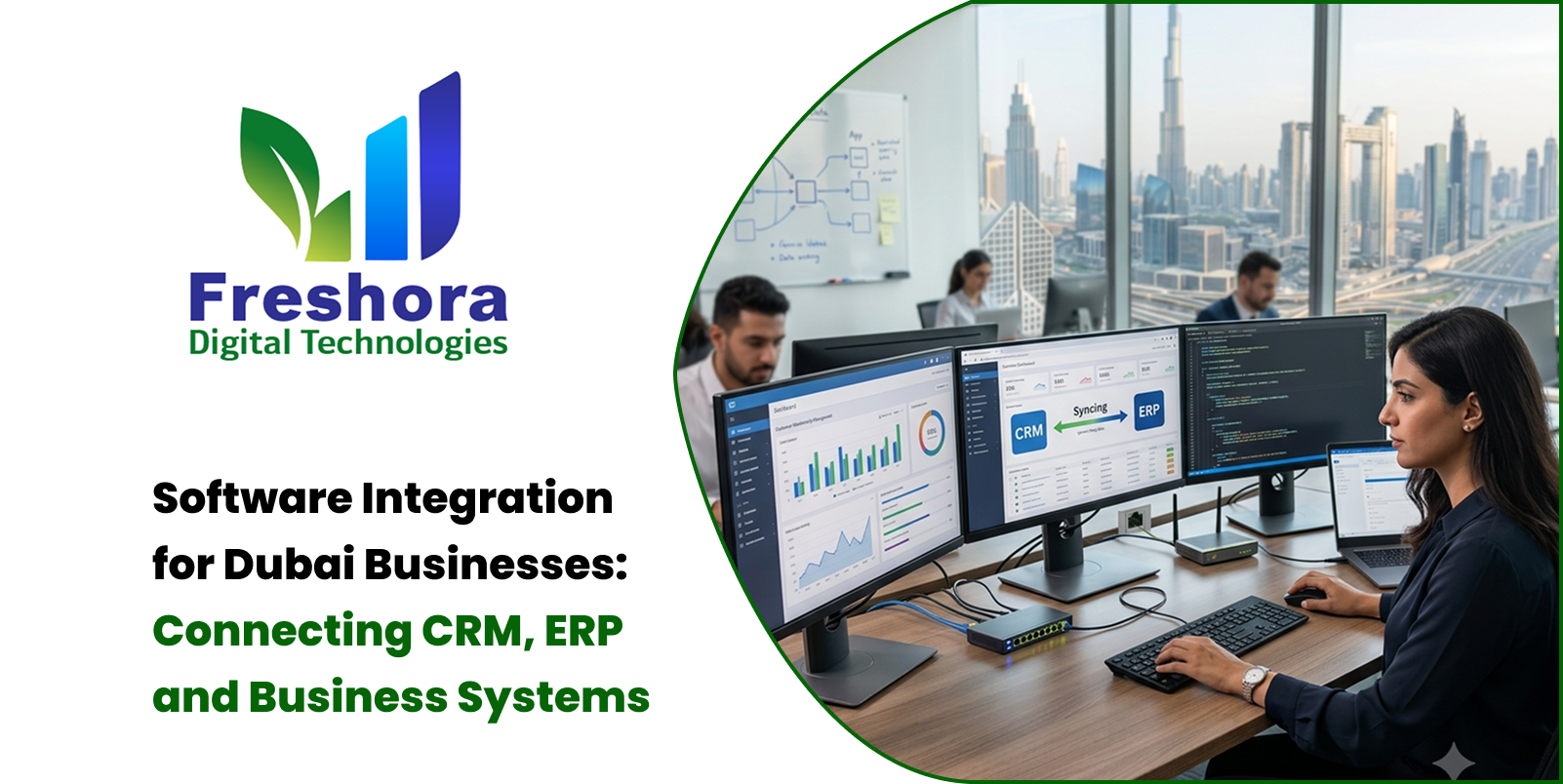
A growing business rarely operates from a single software system. A website may capture enquiries, a... Read More
Our expert will call you shortly to understand your needs and help grow your business.
Get exclusive digital marketing tips, SEO insights, web & app updates, and job opportunities delivered straight to your inbox.
Join our WhatsApp channel for instant digital marketing tips, SEO insights, web & app updates, and latest job opportunities.
Join NowFreshora Digital Technologies proudly serves businesses across Tiruchirappalli (Trichy), including Cantonment, Puthur, Thillai Nagar, Palakarai, Subramaniyapuram, Mela Chinthamani, Woraiyur, KK Nagar, Karumandapam, Crawford, Edamalaipatti Pudur (EMP), Kattur, Airport Area, Ariyamangalam, Panjappur, Thuvakudi, Tiruverumbur, BHEL Township, Srirangam, Thiruvanaikaval, Samayapuram, No.1 Tollgate, Central Bus Stand Area, and Chathiram Bus Stand Area.
We also serve clients across Tamil Nadu, India, and globally in Singapore, the UAE, Saudi Arabia, Canada, Australia, the United Kingdom, and the United States, delivering innovative Website Development, Mobile App Development, Software Development, SEO, Google Business Profile Management, and Digital Marketing solutions that help businesses grow and succeed in the digital world.

