
Contact our team for professional guidance and solutions.
Backlinks remain an important part of a strong SEO ecosystem because they can connect a website with relevant external sources, strengthen discovery, and contribute to the broader authority of important pages. However, effective link building is no longer about collecting the largest possible number of links. Google explains that links can help it discover pages and understand relevance, while its current guidance encourages websites to earn links through unique, compelling content rather than artificial link schemes. A modern backlink strategy therefore focuses on relevance, editorial value, contextual placement, source quality, digital relationships, and content worth referencing.
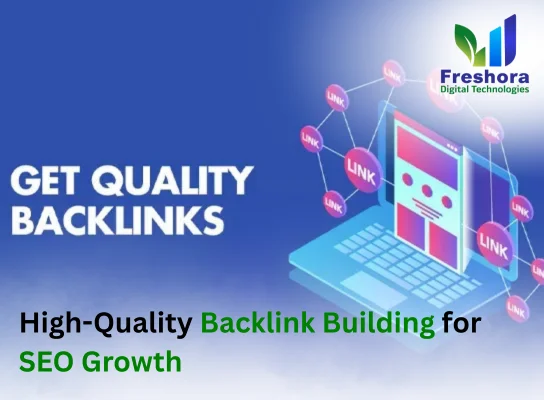
High-Quality Backlink Building for SEO Growth means earning relevant links from credible websites through valuable content, original insights, useful resources, digital PR, industry relationships, and strategically developed linkable assets.
The strongest approach is:
Research → Create Linkable Assets → Outreach → Earn Relevant Mentions → Strengthen Authority → Measure → Refine
Google uses links as one signal for discovering pages and understanding relationships between content.
Google recommends creating unique, compelling content that naturally attracts references and links.
An Ahrefs study analysing 44,589 SERPs found that several backlink-related metrics correlated with ranking performance, while also showing that no single backlink metric explains rankings by itself.
Google's spam policies specifically address paid links, excessive link exchanges, automated link creation, and other manipulative practices.
Context matters: a relevant editorial mention can be considerably more strategically useful than a large collection of unrelated links.
A strong website can publish excellent content and still need external recognition to expand its search presence across competitive topics. High-Quality Backlink Building for SEO Growth creates that external connection by earning relevant references from websites, publications, communities, and industry resources that genuinely have a reason to mention the business. The modern approach is centred on creating information worth citing, developing meaningful digital relationships, and securing contextual mentions that strengthen the website's overall search ecosystem.
A backlink is a hyperlink from another website to a page on your website.
For example:
Industry Website → Your Service Page
or
Research Publication → Your Original Study
or
Local Business Resource → Your Local Guide
High-quality link building focuses on acquiring links where the surrounding context, source, destination, and audience make sense.
The value proposition can be viewed as:
Relevant Source + Useful Content + Natural Context = Stronger Link Opportunity
The objective is not simply to increase the backlink count.
It is to develop a credible network of references around the website.
Google's documentation explains that links help its systems discover new pages and understand relationships between pages. It also recommends using descriptive anchor text so users and search engines can better understand linked content.
This gives backlinks several strategic roles.
Links can provide pathways through which crawlers discover content.
A relevant link can help establish a relationship between two resources.
References from established websites can strengthen the wider credibility ecosystem around a business.
A useful backlink can introduce the brand directly to another website's audience.
Editorial mentions can expose the company to customers who may never have discovered it through direct search.
|
Backlink research insight |
Value |
|
SERPs analysed in Ahrefs study |
44,589 |
|
Ranking pages studied per keyword |
Top 10 |
|
Search-volume range studied |
2,000–5,000 monthly searches |
|
Strongest correlating metric identified in the study |
URL Rating (UR) |
|
SERPs where every top-ranking page had a traffic-generating backlink |
20 |
|
Approximate frequency of those SERPs |
1 in 2,229 |
The Ahrefs study is a correlation analysis rather than proof that backlinks directly caused rankings. Its findings illustrate why backlink quality should be assessed using multiple attributes rather than a single metric.
A professional backlink campaign can follow this framework:
Business Research
↓
Competitor Link Analysis
↓
Content Opportunity Identification
↓
Linkable Asset Creation
↓
Relevant Outreach
↓
Editorial Placement
↓
Performance Monitoring
↓
Relationship Development
This approach makes link building part of the broader content and SEO strategy.
Start by understanding:
Existing referring domains.
Important linked pages.
Anchor-text patterns.
Industry relevance.
Competitor backlink opportunities.
Unlinked brand mentions.
Lost or broken backlinks.
Content already attracting references.
This creates a strategic baseline.
Competitor analysis can reveal websites that already reference businesses within the same industry.
The question becomes:
“Which relevant sources are already interested in this subject?”
From there, opportunities can be grouped into:
Industry publications.
Business directories.
Local resources.
Professional associations.
Educational resources.
News websites.
Partner websites.
Industry blogs.
This is more strategic than contacting hundreds of unrelated websites.
The best backlink campaigns often begin with something genuinely worth referencing.
Examples include:
Publish unique survey findings, market observations, or industry data.
Create carefully sourced collections of useful industry statistics.
Develop comprehensive resources that answer an important business question.
Interactive tools can naturally attract references when they solve a recurring problem.
Useful checklists, worksheets, planning templates, and downloadable resources can become reference points.
Original business results can provide evidence that other writers may cite.
A detailed Trichy business guide, industry directory, or local market resource can create geographically relevant link opportunities.
This is where Organic Link Building Techniques become closely connected to content strategy.
Evaluate potential sources based on:
Topical relevance + audience relevance + editorial quality + page context + genuine usefulness
A website does not become valuable simply because it has a high domain metric.
A smaller specialist publication with the right audience can be strategically more useful than a large but unrelated website.
Generic:
“Dear Sir/Madam, please add our link.”
is rarely a strong outreach strategy.
A better message explains:
Why the resource is relevant.
What specific content could improve the existing article.
Why the audience would benefit.
What unique information your business provides.
The outreach should feel like a professional content recommendation rather than a link request.
Editorially relevant placements can include:
Expert contributions.
Original research references.
Industry interviews.
Resource-page inclusion.
Case-study references.
Expert roundups.
Relevant guest contributions.
Digital PR coverage.
The surrounding context should naturally explain why the destination page is useful.
Track:
New referring domains.
Lost backlinks.
Linked pages.
Anchor text.
Referral traffic.
Relevant mentions.
Authority trends.
Competitor link acquisition.
This reveals which link-building activities are generating meaningful opportunities.
|
Strategy |
Best use |
|
Digital PR |
Brand and authority exposure |
|
Original research |
Earn citations |
|
Expert contributions |
Demonstrate expertise |
|
Resource outreach |
Promote useful assets |
|
Industry partnerships |
Relevant business relationships |
|
Local citations |
Geographic visibility |
|
Unlinked mentions |
Convert existing recognition into references |
|
Broken-link opportunities |
Replace outdated resources |
|
Case-study promotion |
Demonstrate real-world results |
|
Linkable tools |
Attract natural references |
Relevant external references can contribute to a stronger overall search presence.
Links create additional pathways through which users and crawlers can discover valuable pages.
A backlink can directly introduce potential customers to the business.
Being mentioned by respected publications can extend brand reach beyond search results.
Consistent references can strengthen the business's digital footprint within its niche.
A strong external reference profile can complement technical SEO, content quality, and on-page optimisation.
Thousands of weak links do not automatically create a stronger SEO strategy.
A backlink should make contextual sense for the source and destination.
Natural link profiles contain varied and contextually appropriate anchor text.
Google's spam policies specifically address automated link-generation schemes.
Google's spam policies identify buying or selling links for ranking purposes as a violation.
Repeated “you link to me, I link to you” arrangements can become a manipulative pattern.
A backlink campaign is stronger when the linked page provides substantial value to the reader.
Build assets worth referencing.
Prioritise relevance over raw link volume.
Research the audience behind each target website.
Personalise outreach.
Create original research and statistics.
Develop expert-led resources.
Use natural anchor text.
Strengthen internal links after earning external links.
Monitor new and lost referring domains.
Evaluate referral traffic as well as SEO value.
Develop long-term publisher relationships.
Keep every link acquisition activity aligned with genuine user value.
Google recommends descriptive anchor text and explains that links should provide useful context for users and search engines.
Instead of creating content that competes only for rankings, develop information that competitors cannot easily reproduce.
For example:
Industry Data → Original Analysis → Visual Chart → Expert Commentary → Downloadable Resource
This creates a content asset with multiple reasons for journalists, bloggers, businesses, and industry professionals to reference it.
The strategy becomes:
Create something unique → Promote it strategically → Earn references → Update it → Promote again
This creates a more durable backlink acquisition engine.
Consider a Trichy-based digital marketing company that wants to increase authority around SEO.
Instead of publishing ten generic articles, it could create:
“Trichy Business Digital Visibility Report 2026”
The report could analyse:
Local business website trends.
Google Business Profile adoption.
Website performance patterns.
Common local SEO gaps.
Industry-specific observations.
Original survey findings.
The company can then promote the report to:
Local business publications + industry websites + business communities + professional networks + relevant media
The result is a single original asset with multiple potential promotional pathways.
This is significantly more distinctive than requesting generic backlinks to a service page.
For businesses seeking SEO Backlink Building Services, the process can begin with a backlink profile and competitor opportunity analysis to identify relevant publications, industry resources, local websites, content gaps, unlinked mentions, and pages with strong link potential. The strategy can then develop linkable assets such as expert guides, original statistics, case studies, industry resources, and data-led content.
The outreach programme can focus on relevant publishers and business ecosystems while the SEO team monitors referring domains, linked pages, referral traffic, anchor-text patterns, and authority development. This creates backlink acquisition as an integrated part of the wider SEO strategy rather than treating link building as an isolated monthly activity.
Backlink building should focus on quality, relevance, context, and usefulness.
Google uses links as one mechanism for discovering pages and understanding content relationships.
Original research is one of the strongest ways to create genuinely linkable content.
Digital PR can combine brand visibility with relevant external references.
Competitor backlink analysis can reveal valuable outreach opportunities.
High-authority backlinks are most useful when they are also relevant.
Natural anchor text creates clearer context for users and search engines.
Internal links should support externally promoted pages.
Automated link schemes, paid ranking links, and excessive link exchanges should not form part of a professional strategy.
The strongest campaigns create content assets first and backlink opportunities second.
Backlink performance should be measured alongside referral traffic, visibility, and broader SEO growth.
High-quality backlink building is most effective when it is treated as a strategic extension of content, authority, and brand development rather than a race to accumulate links. The modern approach combines original research, useful resources, expert contributions, digital PR, relevant industry relationships, and carefully targeted outreach to create references that make genuine sense for both publishers and audiences. Google's current documentation confirms that links help with discovery and relevance, while its guidance also encourages unique, compelling content as the foundation for earning natural references. By developing content that deserves to be cited and connecting it with the right digital audiences, businesses can build a stronger external authority profile that supports broader organic search growth, brand visibility, and long-term SEO performance.
Zero-Click Searches: Understanding Visibility When Users Stay on Google Zero-click searches occur w... Read More

In the vibrant city of Tiruchirappalli, where culture and tradition meet, photography studios often... Read More
Blog Summary: In the competitive digital landscape of Trichy, your website's visibility is the found... Read More
Our expert will call you shortly to understand your needs and help grow your business.
Get exclusive digital marketing tips, SEO insights, web & app updates, and job opportunities delivered straight to your inbox.
Join our WhatsApp channel for instant digital marketing tips, SEO insights, web & app updates, and latest job opportunities.
Join NowFreshora Digital Technologies proudly serves businesses across Tiruchirappalli (Trichy), including Cantonment, Puthur, Thillai Nagar, Palakarai, Subramaniyapuram, Mela Chinthamani, Woraiyur, KK Nagar, Karumandapam, Crawford, Edamalaipatti Pudur (EMP), Kattur, Airport Area, Ariyamangalam, Panjappur, Thuvakudi, Tiruverumbur, BHEL Township, Srirangam, Thiruvanaikaval, Samayapuram, No.1 Tollgate, Central Bus Stand Area, and Chathiram Bus Stand Area.
We also serve clients across Tamil Nadu, India, and globally in Singapore, the UAE, Saudi Arabia, Canada, Australia, the United Kingdom, and the United States, delivering innovative Website Development, Mobile App Development, Software Development, SEO, Google Business Profile Management, and Digital Marketing solutions that help businesses grow and succeed in the digital world.

