Real Estate
Project pages, property information, galleries, location context and enquiry journeys.

Websites built around Indian customers, real business goals and the way people use the web today
A useful starting point includes the business goal, target audience, services or products, existing website or content, brand assets, preferred page types and any important integrations.
Our website development services in India cover business websites, corporate websites, service websites, e-commerce websites, content-led sites, responsive builds, website redesigns, CMS implementation and practical integrations. Specialist software, app or platform requirements can stay separate from the core website when the project demands them.
India had 109.279 crore internet subscribers in March 2026, with broadband subscribers at 106.588 crore. That scale makes mobile performance, clear navigation, fast pages and reliable website foundations part of the basic requirement rather than optional extras.
We also plan for the reality of an Indian audience: people may discover a business through search, a shared WhatsApp link, a regional-language query, a marketplace, a map listing or a festival-season promotion before they ever visit the website directly. Our regional technology services and regional website development work are examples of how a broader digital approach can be adapted to local business needs.

We group website work by the role the site needs to play. A corporate website builds credibility, a service website explains an offer, a catalogue helps people compare products and an e-commerce site takes the visitor through a buying journey. Each needs a different page structure even though all of them are websites.
A strong website should be easy to extend without becoming messy. New services, products, locations, blogs, case studies and campaigns should have a clear place in the architecture rather than forcing the whole site to be rebuilt each time.
For businesses moving into online selling, our e-commerce guide gives useful background on the website components that support product discovery and online purchasing.
We start with the business question behind the website: what should a visitor understand, trust or do after arriving on a page? That answer shapes the sitemap, navigation, page purpose and content hierarchy before development begins.
This keeps the website development page focused on the website itself rather than trying to become the home for separate software, app, SEO or advertising services.
We review the business model, audience, offer, existing website, content, competitors and the actions that matter most to customers.
We organise the sitemap, navigation, page hierarchy, content requirements and conversion paths before pages are built.
We develop the approved website with responsive layouts, practical functionality, performance and accessibility in mind.
We review important pages, forms, links, menus, content presentation and device behaviour before launch.
Technology should remove friction. We choose a CMS, WordPress setup, e-commerce platform or custom website approach according to the site's actual requirements, budget, editing needs and future growth.
Our wider technology capabilities help when a website needs to connect with another system, but this pillar page keeps the website at the centre: the public-facing experience, its structure, performance and ability to support the business.
India is a broad digital market. The same business can serve a metropolitan audience, Tier-2 and Tier-3 customers, regional-language users and customers who arrive from social or messaging channels. The website needs to stay clear without pretending every audience behaves in the same way.
TRAI recorded 109.279 crore internet subscribers in March 2026. India's online shopper base was estimated at nearly 29–30 crore in 2025, while around 65% of new shoppers came from Tier-2 and smaller cities. For website planning, that means regional demand deserves the same attention as metro traffic.
That is why localisation should be useful rather than decorative: clear service coverage, relevant language, familiar terminology, genuine business information and content that answers the questions customers actually ask. Our regional IT market comparison research also shows why local competitive context can matter when shaping a digital presence.
Good localisation is not repeating a city or the word “India” on every page. It is making the website understandable to the people the business genuinely serves.
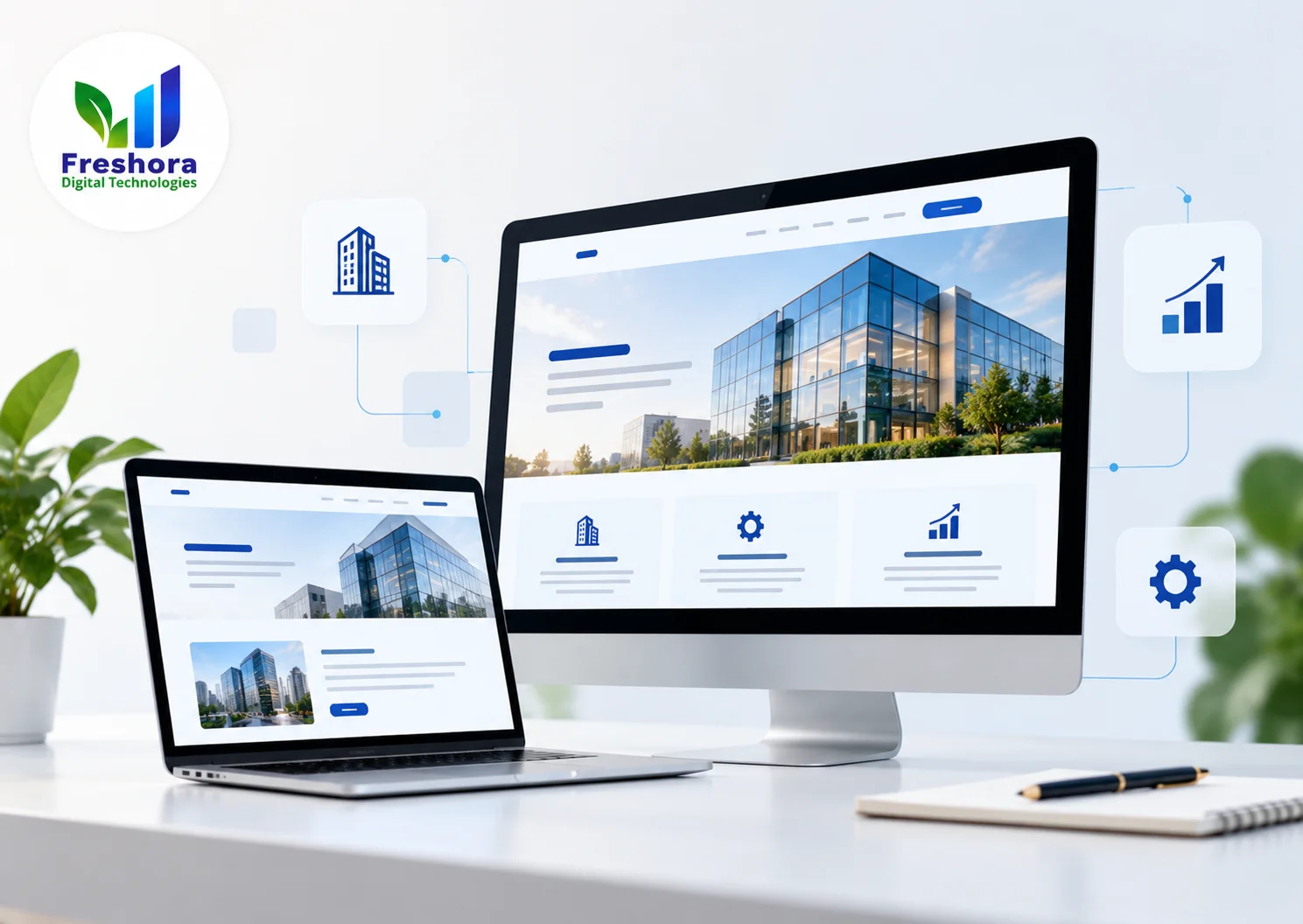
For corporate businesses, the website often becomes the first place a prospect, supplier, employee or partner checks before deciding whether to start a conversation.
We build those pages around proof that helps a visitor make that decision: services, capabilities, industries, projects, credentials, leadership, company information, case studies and straightforward contact paths.
The objective is simple: when someone reaches the website, they should understand what the company does, why it matters and what to do next.
For e-commerce businesses, the website has a different job. Product discovery, category structure, product information, pricing, checkout and support need to work together, while the wider site still remains easy to crawl and manage.
Indian commerce also has strong seasonal rhythms. Diwali, Pongal, Onam, Navratri, Durga Puja, Ganesh Chaturthi, Eid and other local buying periods can influence what businesses promote and when. A good website structure leaves room for these campaigns without turning every festival into the same template.
Many businesses do not need a complicated application just to have a better website. A tailored website becomes useful when the brand, page types, content model, enquiry flow or integrations need something more specific than an off-the-shelf theme can provide.
Create consistent page types for services, products, industries, blogs or campaigns without forcing every page into one layout.
Give the team reusable sections for proof, enquiries, galleries, downloads, FAQs and other recurring content.
Build multi-step or condition-based enquiry forms when a simple contact form is not enough.
Present products or services clearly with categories, filters, specifications or supporting information.
Connect the website to agreed payment, analytics, messaging or external tools where that improves the customer journey.
Support genuine branches, service areas or market sections without duplicating content unnecessarily.
Make important parts of the site easier for the business team to update after launch.
Leave room for new pages, content and functionality without forcing a complete redesign later.
We do not recommend a more complex build simply because it sounds more advanced. The right choice depends on the number of pages, editing requirements, design needs, integrations, performance expectations and how the website will be managed after launch.
The key decision is not “custom or standard?” It is “what does this website need to do exceptionally well for the business?”
Search visibility starts with the website's foundation. Page relationships, crawlable navigation, headings, internal linking, performance and mobile usability help search engines interpret the site.
We therefore consider search requirements while the website is being planned and developed, while keeping this page focused on website development rather than positioning it as a separate SEO service page.
People increasingly search with complete questions, compare brands across several sources and arrive from AI-assisted or answer-oriented search experiences. Clear organisation information, service descriptions, FAQs and trustworthy page content make the website easier for both people and modern search systems to interpret.
India's Digital Personal Data Protection Rules, 2025 were notified by MeitY in November 2025. Website forms, customer accounts, analytics and other personal-data workflows should therefore be considered during website planning, with privacy and security decisions made according to the site's actual data practices.
For e-commerce businesses, the Consumer Protection (E-Commerce) Rules, 2020 remain relevant to consumer-facing information and processes. For government websites, GIGW 3.0 provides the dedicated quality, accessibility and cybersecurity framework, including alignment with WCAG 2.1 Level AA.
The exact obligations depend on the organisation, the audience and the information the website collects. Our role is to give the development team a sound technical foundation so relevant requirements can be considered during the build.
India's language diversity matters at the interface level. Depending on the audience, a site may need English with Hindi, Tamil, Telugu, Kannada, Malayalam, Bengali, Marathi, Gujarati, Punjabi or another regional language.
A multilingual website is more than translated paragraphs. Navigation, typography, button labels, images, forms, language switching and content hierarchy all need room to work naturally in each language.
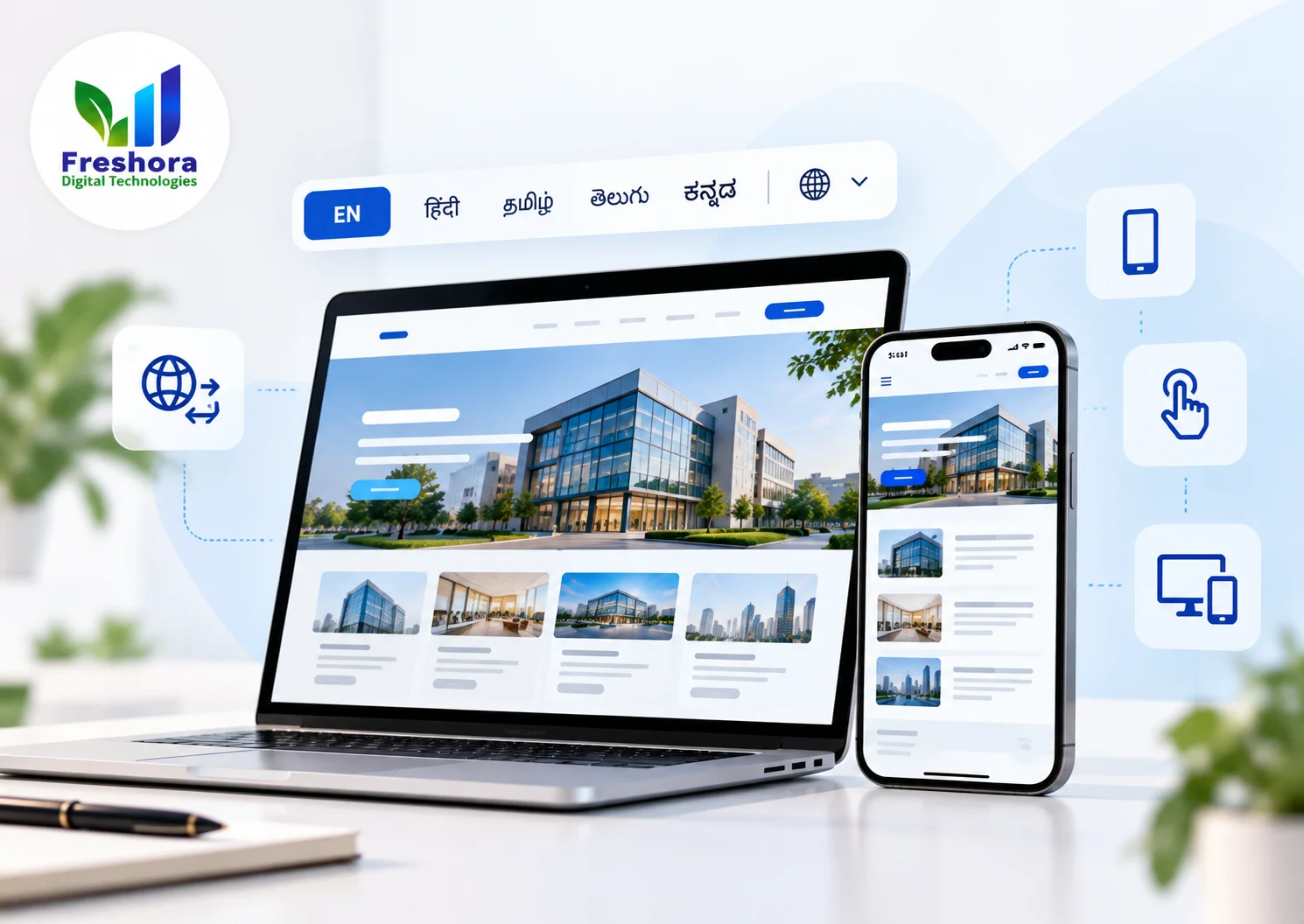
With more than 1.09 billion internet subscribers recorded by TRAI in March 2026, mobile-first thinking is a practical baseline for Indian website development.
A website for one industry can look very different from another, but the underlying development work still comes back to clear information, useful journeys, reliable performance and easy management.
Project pages, property information, galleries, location context and enquiry journeys.
Service information, departments, doctor profiles, appointment requests and patient-friendly navigation.
Course pages, admissions information, programmes, campus details and enquiry paths.
Clear service explanations, trust-building information, forms and straightforward customer journeys.
Product discovery, categories, offers, checkout journeys and customer support information.
Destinations, rooms, packages, experiences, bookings and mobile-friendly planning pages.
Products, capabilities, certifications, industries served, downloads and B2B enquiry paths.
Service coverage, quotation requests, shipment information and business contact journeys.
Vehicles, models, services, dealership information, campaigns and enquiry or booking paths.
Expertise, services, proof, team information, case studies and lead-generation pages.
Solutions, product information, demonstrations, resources and clear routes into the product.
Menus, products, offers, locations, ordering and local discovery experiences.
Projects, capabilities, sectors, certifications, galleries and enquiry-focused website structures.
Services, treatments, offers, locations, galleries and appointment journeys.
Products, distributors, practical information and region-aware customer pathways.
Practical company websites, service pages, catalogues and scalable content structures.
An existing website already contains assets that took time to earn: URLs, indexed pages, backlinks, content, user behaviour and sometimes years of search history. We review those assets before deciding what should change.
Before redevelopment, we can check:
The objective is a better website without casually discarding useful work. Where an old structure has value, we protect it; where it creates friction, we improve it.
Each stage has a clear purpose, so the team can make decisions before small issues become expensive changes later.
We understand the business, audience, content, existing site and project requirements.
We plan the sitemap, navigation, page hierarchy, user journeys and content requirements.
We turn the approved structure into page layouts that work across desktop, tablet and mobile screens.
We develop the working website, CMS features, forms, content components and agreed integrations.
We review key pages, links, forms, responsive behaviour, performance and important user journeys before launch.
India's website landscape is increasingly connected to digital payments, messaging and open commerce. UPI recorded 2,451 crore transactions in August 2026, while ONDC had reached more than 20 crore buyers, 5 lakh sellers and 1,000 cities by June 2026.
That does not mean every website needs a marketplace or payment flow. It means the public website should be ready to connect with the wider customer journey when the business genuinely needs it—through payments, enquiries, messaging, analytics, catalogues or other systems.
We believe a website partner should understand both the page visitors see and the practical work the website has to support. With 354+ businesses trusting us across India, 672+ successful project deliveries, 42+ industries served, 45+ skilled digital professionals and experience across 20+ Indian cities, we bring experience from different business situations into website planning and development.
We keep the focus on useful websites: clear content structures, dependable development, practical UX decisions, performance, search-ready foundations and room for the business to grow.
Discuss requirements and project decisions directly with the people handling the work.
Set the pages, functionality, integrations and technical expectations before development gets too far ahead.
Build a website structure that can accommodate new services, products, locations, articles and campaigns later.
Consider search, analytics and important customer actions while the website is being developed, not as an afterthought.
Build with security, accessibility, performance and responsible data handling in mind.
Continue with agreed updates, improvements and technical support after launch.
Our experience comes from real website projects with different page counts, industries, audiences and technical requirements. We share selected work through our case studies so potential clients can see how we approach the brief rather than relying only on promises.
Across 672+ successful project deliveries, the recurring lessons are practical: pages need a reason to exist, navigation needs to make sense, mobile layouts need care and development decisions should leave the business with a website it can actually use.
Explore our case studies to see selected project work and the thinking behind the builds.
We develop corporate websites, business websites, e-commerce websites, service websites, content-led sites and tailored website builds based on the project's requirements.
We begin with the business goal, audience, content, page requirements, user journeys, existing website and technical expectations before finalising the sitemap and development approach.
We plan around mobile usage, clear navigation, regional relevance, language needs, performance, familiar contact methods and the way Indian customers discover and evaluate businesses online.
Yes. Before redevelopment, we can review important URLs, indexed content, backlinks, redirects, search history, internal links and key user journeys so useful existing assets are not changed blindly.
Yes. We can plan language switching, typography, content hierarchy and responsive behaviour for multilingual websites.
Yes. Where required by the website, we can connect agreed payment, messaging, analytics, forms or external tools while keeping the public website clear and maintainable.
A useful starting point is the business goal, target audience, services or products, existing website or content, brand assets, preferred page types and any essential integrations.
Tell us what your business needs the website to communicate, how customers should use it and what the site needs to support. With 354+ businesses supported across India, 672+ successful project deliveries, 42+ industries served and 45+ digital professionals, we bring practical experience to the process from planning through launch.
Clear structure. Strong development. A website ready for real customers.
Get exclusive digital marketing tips, SEO insights, web & app updates, and job opportunities delivered straight to your inbox.
Join our WhatsApp channel for instant digital marketing tips, SEO insights, web & app updates, and latest job opportunities.
Join NowFreshora Digital Technologies proudly serves businesses across India, including Chennai, Trichy (Tiruchirappalli), Madurai, Coimbatore, Salem, Erode, Tirunelveli, Thoothukudi, Thanjavur, Vellore, Tiruppur, Dindigul, Karur, Pudukkottai, Kanyakumari, Bengaluru, Mysuru, Mangaluru, Hubballi, Belagavi, Hyderabad, Visakhapatnam, Vijayawada, Guntur, Tirupati, Kochi, Thiruvananthapuram, Kozhikode, Thrissur, Mumbai, Pune, Nashik, Nagpur, Thane, Navi Mumbai, Delhi, Gurugram, Noida, Faridabad, Ghaziabad, Chandigarh, Ludhiana, Amritsar, Ahmedabad, Surat, Vadodara, Jaipur, Jodhpur, Udaipur, Lucknow, Kanpur, Varanasi, Agra, Kolkata, Bhubaneswar, Patna, Ranchi, Raipur, Bhopal, Indore, Guwahati, Dehradun, and other major cities and business centres across India.
We provide Website Development, Mobile App Development, Software Development, SEO Services, Google Business Profile Management, Google Ads, Meta Ads, Digital Marketing, UI/UX Design, E-commerce Development, Cloud Solutions, and AI Solutions to businesses across India. Our services are tailored to different industries, business sizes, and market requirements, helping organisations strengthen their online visibility, generate qualified enquiries, improve customer engagement, and achieve sustainable business growth. Beyond India, Freshora Digital Technologies also serves international clients across Singapore, the United Arab Emirates (UAE), Saudi Arabia, Qatar, Kuwait, Bahrain, Oman, Malaysia, Canada, Australia, the United Kingdom, and the United States. We deliver digital technology and marketing solutions tailored to local markets and the unique needs of businesses worldwide.

