Contact our team for professional guidance and solutions.
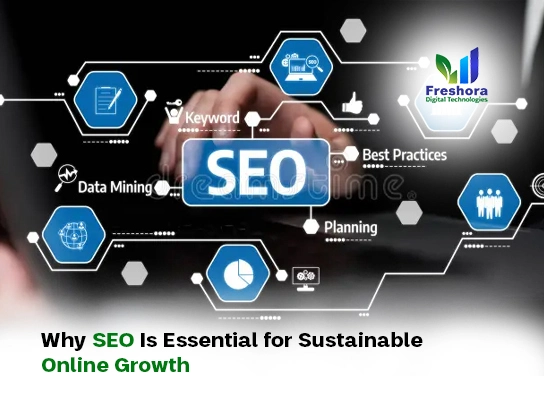
Many businesses want online growth but build their strategy around short-term visibility: run an advertisement, generate traffic, stop spending and watch the traffic disappear. SEO works differently. SEO for Sustainable Online Growth focuses on building a website that can continuously attract relevant searches, answer customer questions, strengthen trust and create opportunities without paying for every individual visit. Organic search generated more than 1 trillion visits globally during 2025, according to Semrush's analysis, although growth was only 2.38% as search behaviour evolved alongside AI-powered discovery. Sustainable SEO therefore is not about ranking for hundreds of keywords; it is about building durable search assets that remain useful as customer behaviour and search technology change.
SEO supports sustainable online growth by turning a business website into a long-term discovery channel.
A sustainable SEO strategy connects:
Search demand → Useful content → Search visibility → Qualified visitors → Trust → Conversions → Business growth
Unlike a campaign that ends when its budget ends, SEO can continue generating organic discovery from previously optimised pages.
However, sustainable SEO does not mean “set it and forget it.”
It requires:
Continuous content improvement.
Technical maintenance.
Search-intent research.
Internal linking.
Authority building.
Conversion optimisation.
Periodic content updates.
Google's current guidance emphasises helpful, reliable, people-first content and specifically rejects the idea that websites should create content simply to attract search-engine traffic.
Businesses often confuse visibility with sustainable growth.
For example:
A company may rank for a few keywords and receive traffic, but if those visitors are irrelevant, rankings alone do not create growth.
Another business may receive thousands of visitors but very few enquiries because its landing pages do not address customer needs.
A sustainable strategy therefore asks four questions:
Are the right people finding us?
Are they finding the right pages?
Does the content satisfy their intent?
Can those visitors take a meaningful next step?
This is why SEO should be connected to the entire customer journey rather than treated as a ranking exercise.
Your SEO foundation may need improvement if:
Organic traffic disappears whenever advertising stops.
Competitors consistently appear for important customer searches.
Your website has many pages but little search visibility.
Blog topics are selected randomly.
Service pages are thin or generic.
Existing content is rarely updated.
Your website ranks for irrelevant keywords.
Search traffic does not generate meaningful enquiries.
There is no clear internal-link structure.
Technical SEO issues repeatedly appear.
Content is produced mainly to meet a publishing quota.
SEO reports focus only on rankings instead of business outcomes.
One of the biggest warning signs is growth without durability.
If visibility depends entirely on constant promotion, the business has built traffic—not necessarily a sustainable acquisition system.
A strong SEO for Business Growth strategy can support several stages of the customer journey.
|
Customer Need |
SEO Asset |
|
Understand a problem |
Educational content |
|
Explore solutions |
Guides and comparison pages |
|
Find a provider |
Service pages |
|
Find a local business |
Local SEO assets |
|
Evaluate credibility |
Case studies and proof |
|
Make a decision |
Product/service pages |
|
Take action |
Conversion-focused landing pages |
This creates a connected ecosystem rather than isolated blog posts.
For example:
“What is SEO?”
↓
“How SEO works for businesses”
↓
“SEO services”
↓
Case study
↓
Enquiry
The visitor is gradually moved from information to confidence to action.
Semrush's analysis of worldwide traffic across 17 industries found that organic search generated over 1 trillion visits in 2025. Organic traffic grew 2.38%, while AI traffic grew 66.02% from a much smaller base.
What this means: Organic search remains a major acquisition channel even as AI-driven discovery grows.
Semrush reported that AI traffic increased by 66.02% during 2025, but still represented less than 0.15% of total web visits in its dataset.
What this means: Businesses should adapt to AI search without prematurely abandoning traditional organic search.
HubSpot's blogging research found that 49% of businesses maintaining blogs use blogging for lead generation, while 66% use it for brand awareness.
What this means: Content can serve commercial objectives when it is connected to customer needs and conversion paths.
HubSpot found that 83% of businesses with blogs distribute their content through social media, demonstrating that organic content does not have to operate inside a single marketing channel.
What this means: A strong SEO asset can also support social, email and other distribution channels.
Google explicitly states that creators should not write to a specific word count because they believe Google has a preferred length.
What this means: Sustainable content strategy should prioritise completeness and usefulness instead of publishing artificially long articles.
More content does not automatically mean more visibility.
Google warns against producing large amounts of content across many topics simply in hopes that some pages will perform in search.
A 50,000-search-volume keyword may produce less business value than a 500-search-volume commercial query.
AI can support research and workflow efficiency, but Google states that using automation primarily to manipulate rankings violates its spam policies.
Some of the easiest SEO opportunities already exist on the website.
A page ranking at position 11 may require improvement—not replacement.
Traffic is only one stage of the journey.
The real question is:
Did the organic visitor become a qualified opportunity?
Technical issues, competitors, search behaviour and content expectations change continuously.
The stronger Sustainable SEO Strategies model is based on compounding value.
Instead of publishing hundreds of unrelated pages, build a focused ecosystem around the topics that matter most to your customers.
Understand customer searches.
↓
Create useful pages and resources.
↓
Strengthen internal links and topic relationships.
↓
Add experience, evidence and original insight.
↓
Improve pages using actual performance data.
↓
Turn relevant organic visitors into business opportunities.
↓
Update and strengthen valuable assets.
↓
Build the next layer of organic visibility.
This creates an SEO system rather than a publishing routine.
Decide what SEO needs to achieve.
For example:
More qualified leads.
More local enquiries.
Product discovery.
Expansion into new locations.
Lower dependence on paid acquisition.
Identify what customers search for before they become buyers.
A simple framework is:
Problem → Research → Solution → Provider → Decision
Create content for the journey rather than targeting isolated keywords.
Evaluate each topic using:
Search demand + business relevance + ranking opportunity + conversion potential
This prevents the team from wasting resources on impressive-looking but commercially weak keywords.
Start with:
Homepage.
Service pages.
Product pages.
Location pages.
High-value landing pages.
These pages often have greater direct business value than another generic blog article.
Once core pages are strong, create supporting resources that answer related questions.
For example:
SEO Service Page
can be supported by:
SEO pricing guide.
SEO process guide.
Technical SEO guide.
SEO measurement guide.
SEO case study.
This creates a topical network.
Google's people-first guidance asks whether content demonstrates first-hand expertise and depth of knowledge.
Include:
Real examples.
Lessons learned.
Original analysis.
Case studies.
Expert commentary.
Customer questions.
Industry-specific observations.
This makes content harder to replace with generic information.
Review:
Crawlability.
Indexing.
Page speed.
Mobile experience.
URL structure.
Internal links.
Redirects.
Canonicals.
Structured data where appropriate.
A great article cannot deliver its full value if search engines struggle to discover or understand the page.
Link related pages logically.
For example:
Pillar page → Supporting article → Service page → Case study
Internal linking helps users navigate the site while helping search engines discover related content.
Every important organic landing page should answer:
What should the visitor do next?
Depending on intent, the next step could be:
Request a quote.
Call.
Send an enquiry.
Download a guide.
Book a consultation.
Explore a related service.
Monitor:
Organic impressions.
Organic clicks.
Search visibility.
Qualified traffic.
Engagement.
Leads.
Conversion rates.
Revenue.
Assisted conversions.
A sustainable strategy improves when the data reveals where users are entering, what they need and where they drop off.
When a page already has authority, improve it before creating a replacement.
Update:
Statistics.
Examples.
Outdated recommendations.
Internal links.
Search intent coverage.
FAQs.
Commercial CTAs.
This protects the value already accumulated.
A practical Online Search Visibility Strategies workflow can use:
Google Search Console.
Google Analytics.
Google Trends.
Competitor SERP analysis.
Website crawlers.
PageSpeed Insights.
Conversion tracking.
Content performance dashboards.
The most important method is not a particular software platform.
It is connecting search data with customer and business data.
Search Console can show what people search for.
Analytics can show what visitors do.
CRM data can show whether those visitors become opportunities.
Together, they provide a much clearer picture of sustainable SEO performance.
|
Short-Term SEO Approach |
Sustainable SEO Approach |
|
Chase rankings |
Build useful search visibility |
|
Publish frequently |
Publish strategically |
|
Target high-volume keywords |
Prioritise business-value searches |
|
Focus on traffic |
Focus on qualified traffic |
|
Create isolated blogs |
Build connected topic clusters |
|
Use generic content |
Demonstrate experience |
|
Ignore existing pages |
Continuously improve assets |
|
SEO operates separately |
SEO supports the whole funnel |
|
Measure positions |
Measure business outcomes |
|
Stop after initial work |
Optimise continuously |
For sustainable growth, SEO resources should be distributed according to opportunity rather than publishing volume.
A practical priority framework is:
Fix technical and indexing problems affecting important pages.
Optimise pages already receiving impressions or ranking close to page one.
Build supporting content around proven commercial topics.
Add research, case studies, original data and expert insights.
Improve landing-page experience and CTAs.
Update valuable content as search intent and industry information change.
Google's current guidance for AI search also reinforces the importance of unique, satisfying content that adds value rather than simply reproducing information available elsewhere.
For businesses considering SEO Services in Trichy, this means choosing a strategy based on business goals, customer search behaviour, content quality, technical health and measurable outcomes—not simply the number of keywords reported each month.
Treating SEO as a one-time project.
Publishing content without a customer purpose.
Chasing every trending keyword.
Measuring success only through rankings.
Ignoring conversion tracking.
Creating multiple pages for the same search intent.
Removing useful pages without analysing their value.
Using outdated statistics.
Copying competitors.
Producing generic AI content at scale.
Ignoring technical SEO.
Forgetting local search opportunities.
Building content without internal links.
Stopping investment after a temporary ranking decline.
Prioritising traffic volume over lead quality.
The central rule is simple:
Do not create more pages merely to have more pages. Create better assets that solve better problems.
Business goals are defined.
Customer search journeys are mapped.
Commercial search opportunities are prioritised.
SEO KPIs connect to business objectives.
Important pages are indexable.
Service and product pages are useful.
Internal links are logical.
Mobile experience is strong.
Technical issues are monitored.
Content is created for people first.
Search intent is clear.
Original insights are included.
Experience is demonstrated.
Sources are credible.
Existing content is regularly reviewed.
Organic landing pages have relevant CTAs.
Contact options are easy to find.
Trust signals are visible.
Lead tracking is configured.
Search Console is monitored.
Organic traffic is segmented.
Qualified leads are tracked.
Conversion rates are measured.
SEO contribution to revenue is reviewed.
SEO is most valuable when treated as a long-term business growth system.
Organic search generated more than 1 trillion visits in 2025 according to Semrush's analysis.
AI is changing search behaviour, but organic search remains a major discovery channel.
Sustainable SEO prioritises quality over publishing volume.
Search intent should guide content decisions.
Existing pages can be valuable growth assets.
First-hand experience and original information strengthen content quality.
Technical SEO and content strategy must work together.
Internal linking creates stronger relationships between pages.
SEO should be measured through qualified traffic, leads and business outcomes.
Paid, social, content and organic search can support one another.
Google recommends people-first content rather than search-engine-first publishing.
The best long-term strategy is to build, measure, improve, refresh and reinvest.
SEO becomes essential for sustainable online growth when a business stops chasing temporary rankings and starts building a website that consistently answers customer needs, earns visibility and supports conversions over time. Freshora Digital Technologies can implement this through search-intent research, technical audits, strategic content planning, commercial page optimisation, internal-link architecture, experience-led content and continuous performance analysis, creating an organic growth system rather than a collection of isolated SEO tasks. As search expands into AI-powered experiences and user behaviour continues to change, businesses that invest in useful, original and trustworthy digital assets will be better positioned to maintain visibility and generate opportunities for the long term.
Zero-Click Searches: Understanding Visibility When Users Stay on Google Zero-click searches occur w... Read More

In the vibrant city of Tiruchirappalli, where culture and tradition meet, photography studios often... Read More
Blog Summary: In the competitive digital landscape of Trichy, your website's visibility is the found... Read More
Our expert will call you shortly to understand your needs and help grow your business.
Get exclusive digital marketing tips, SEO insights, web & app updates, and job opportunities delivered straight to your inbox.
Join our WhatsApp channel for instant digital marketing tips, SEO insights, web & app updates, and latest job opportunities.
Join NowFreshora Digital Technologies proudly serves businesses across Tiruchirappalli (Trichy), including Cantonment, Puthur, Thillai Nagar, Palakarai, Subramaniyapuram, Mela Chinthamani, Woraiyur, KK Nagar, Karumandapam, Crawford, Edamalaipatti Pudur (EMP), Kattur, Airport Area, Ariyamangalam, Panjappur, Thuvakudi, Tiruverumbur, BHEL Township, Srirangam, Thiruvanaikaval, Samayapuram, No.1 Tollgate, Central Bus Stand Area, and Chathiram Bus Stand Area.
We also serve clients across Tamil Nadu, India, and globally in Singapore, the UAE, Saudi Arabia, Canada, Australia, the United Kingdom, and the United States, delivering innovative Website Development, Mobile App Development, Software Development, SEO, Google Business Profile Management, and Digital Marketing solutions that help businesses grow and succeed in the digital world.

