
Contact our team for professional guidance and solutions.
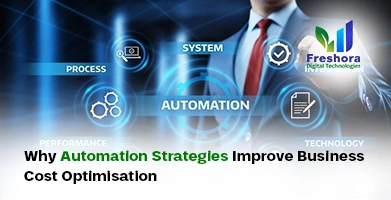
Business Automation Strategies help organizations reduce unnecessary manual effort, improve workflow consistency and make better use of employee time. Automation is no longer limited to large enterprises; cloud platforms, workflow tools, integrations and AI-enabled systems make automation increasingly accessible to growing businesses. IBM reports that 67% of executives surveyed identified cost reduction through automation as a benefit of agentic AI, while 69% identified improved decision-making as a leading benefit. For businesses, however, cost optimisation should not mean simply removing tasks or reducing headcount. The stronger objective is to eliminate avoidable effort, reduce errors, accelerate processes and redirect employees toward activities that generate greater value. This makes Business Process Automation an important strategy for improving operational economics while preparing organizations for sustainable digital growth.
Business Automation Strategies use technology to automate repetitive, rule-based or predictable business activities.
They can help businesses:
● Reduce repetitive manual work
● Minimise data-entry errors
● Speed up approvals
● Improve customer response times
● Reduce process delays
● Lower administrative overhead
● Improve employee productivity
● Create better operational visibility
● Scale processes without proportionally increasing manual effort
The objective is not to automate everything.
The objective is to automate the right processes.
● 67% of executives surveyed by IBM identified cost reduction through automation as a benefit of agentic AI.
● 69% identified improved decision-making as a leading benefit.
● IBM reports that more than 80% of surveyed global operations executives consider automating business services a major strategic imperative.
● Workflow automation can reduce repetitive tasks, manual errors and process-cycle time.
● Cost optimisation should measure the complete process, not just the cost of one task.
● Intelligent automation combines workflows, integrations, data and AI where appropriate.
● Automation is most effective when businesses redesign inefficient processes before digitising them.
● Freshora Digital Technologies can help businesses identify suitable automation opportunities and connect automation with websites, ERP, CRM and other digital systems.
Businesses often try to reduce costs by negotiating supplier prices, cutting unnecessary expenses or increasing employee productivity, but an equally important opportunity exists inside everyday workflows where employees repeatedly enter data, send reminders, prepare reports, obtain approvals, update records and move information between disconnected systems. Business Automation Strategies address these hidden inefficiencies by using technology to execute suitable activities automatically, allowing employees to spend more time on customer service, decision-making, sales and other higher-value responsibilities. IBM notes that workflow automation can reduce manual errors, streamline task management, shorten process cycles and reduce costs. The important shift is therefore from simply asking "How can we spend less?" to asking "How can we perform the same process with less unnecessary effort and greater consistency?" When businesses adopt automation with measurable objectives, Business Process Automation can become a practical tool for Business Cost Optimisation, operational scalability and long-term digital transformation.
Business automation means using technology to execute repetitive business activities with limited manual intervention.
A simple process might look like:
Customer Enquiry → Employee Reads Message → Data Entered → Follow-Up Reminder → Sales Update
An automated version could become:
Customer Enquiry → System Captures Lead → Assigns Salesperson → Sends Notification → Creates Follow-Up Task
The difference is not merely technological.
It changes how employee time is used.
Employees can spend significant time performing repetitive activities.
Examples include:
● Copying customer information
● Generating routine reports
● Sending standard emails
● Updating spreadsheets
● Creating notifications
● Checking routine status updates
Automation can handle suitable repetitive activities consistently.
This does not necessarily mean reducing employees.
It can mean allowing the same team to handle more valuable work.
Manual data entry creates opportunities for:
● Typing mistakes
● Duplicate records
● Incorrect calculations
● Missed updates
● Forgotten follow-ups
Even a small error can create additional costs when it affects several downstream activities.
Automation can reduce errors by transferring information between connected systems automatically.
IBM specifically identifies reductions in manual-entry errors and oversights as a benefit of workflow automation.
Consider an approval process that normally takes:
2 business days
because an employee must manually send reminders.
An automated workflow could notify the appropriate person immediately and escalate delayed approvals.
If the process falls from 2 days to 4 hours, the business gains more than time.
It can potentially:
● Process orders faster
● Respond to customers sooner
● Release purchases earlier
● Improve internal coordination
Automation changes the type of work employees perform.
Instead of:
80% repetitive tasks + 20% valuable work
a business may aim for:
30% repetitive tasks + 70% higher-value work
The exact numbers will differ by business.
The principle is to redirect human effort toward activities where human judgement creates more value.
IBM reports that organizations increasingly view AI-enabled workflows as a way to improve process efficiency and change how employees work.
Imagine a company processing:
1,000 customer enquiries per month
and growing to:
3,000 enquiries per month.
If every enquiry requires the same amount of manual administration, workload increases dramatically.
Automation can handle parts of:
● Lead capture
● Assignment
● Notifications
● Follow-ups
● Data synchronization
This can increase capacity without requiring every administrative activity to grow at the same rate.
Some costs do not appear as direct expenses.
Examples include:
● Employee time spent searching for information
● Rework caused by errors
● Delayed approvals
● Missed leads
● Duplicate data entry
● Manual reporting
● Slow customer responses
These are process costs.
Automation can target these hidden inefficiencies.
Website Enquiry
These workflows can reduce unnecessary administrative intervention.
Suppose 5 employees each spend 2 hours per day on a repetitive administrative task.
That equals:
5 × 2 = 10 hours per day
Over 22 working days:
10 × 22 = 220 hours per month
If automation reduces this workload by 60%:
220 × 60% = 132 hours saved per month
The business can then redirect those 132 hours toward higher-value work.
This is a simplified illustration; actual savings depend on salaries, technology costs, maintenance and the redesigned process.
Traditional automation follows predefined rules.
For example:
If payment is overdue → Send reminder.
Intelligent automation can incorporate:
● AI
● Natural-language processing
● Predictive analytics
● Workflow automation
● Business rules
IBM's 2025 research found that 67% of surveyed executives viewed cost reduction through automation as a benefit of agentic AI, while 69% identified improved decision-making as a leading benefit.
This demonstrates that automation is increasingly moving beyond simple task execution toward decision support and intelligent workflow management.
One of the biggest mistakes businesses make is assuming every task should be automated.
Automation may be unsuitable when a process requires:
● Complex judgement
● Human empathy
● Negotiation
● Creative thinking
● Ethical decisions
● High-risk approval
A better approach is:
Automate repetitive work.
Assist complex work.
Keep critical human decisions under appropriate human control.
ERP systems can provide an important foundation for automation.
For example:
Sales Order
→ Inventory Check
→ Purchase Requirement
→ Invoice
→ Accounting Record
Instead of employees manually transferring information between systems, integrated workflows can allow the ERP to handle parts of the process automatically.
This is especially useful for businesses managing:
● Inventory
● Purchasing
● Sales
● Finance
● Customers
● Employees
CRM automation can help businesses manage:
● Lead assignment
● Follow-up reminders
● Customer segmentation
● Email notifications
● Sales pipeline updates
● Customer communication
For example:
New Lead
→ Sales Assignment
→ Automatic Notification
→ Follow-Up Task
This reduces the chance of enquiries being forgotten.
Cost optimisation should not damage customer experience.
Good automation can actually improve it.
Examples include:
● Instant enquiry acknowledgement
● Order-status notifications
● Appointment reminders
● Payment reminders
● Automated support routing
The customer receives faster communication while employees spend less time performing repetitive communication.
For Freshora Digital Technologies, automation should be approached as a business-process improvement project rather than simply installing an automation tool.
Freshora can help businesses through:
Identify repetitive activities and operational bottlenecks.
Create automated workflows for suitable business processes.
Connect website forms and enquiries with internal business systems.
Automatically transfer leads into CRM systems and initiate follow-up workflows.
Connect sales, inventory, purchasing, finance and other systems where appropriate.
Automate:
● Email alerts
● Internal notifications
● Customer updates
● Follow-up reminders
Automate recurring business reports so managers spend less time compiling information.
Where suitable, AI can assist with:
● Lead classification
● Document processing
● Customer queries
● Content workflows
● Intelligent recommendations
Freshora's objective should be to identify the right automation opportunity first and then select the appropriate technology.
A practical implementation model can follow 6 stages:
Understand the existing process.
Calculate time, cost, volume and error rates.
Select the process with the strongest potential return.
Create the future automated workflow.
Connect the required software and automation tools.
Compare results against the original baseline.
This prevents automation from becoming technology for technology's sake.
Businesses should track numerical KPIs such as:
● Hours saved per month
● Cost per transaction
● Processing time
● Error rate
● Lead response time
● Employee productivity
● Automation rate
● Customer response time
For example:
Before Automation: 15 minutes per transaction
After Automation: 6 minutes
Time Reduction: 60%
This gives management a measurable reason to continue investing in automation.
Technology can make an inefficient process faster without making it better.
Disconnected automation can create another data silo.
Revenue opportunities, customer experience and employee productivity also matter.
Without "before" measurements, ROI becomes difficult to prove.
Some decisions still require human involvement.
Employees need to understand new workflows.
Business Automation Strategies are structured approaches to using technology to automate repetitive processes, improve workflows, reduce manual effort and increase operational efficiency.
It can reduce the time employees spend on repetitive activities, decrease manual errors, shorten process cycles and improve workflow capacity.
Intelligent Business Automation combines traditional workflows with technologies such as AI, analytics and machine learning to automate or assist more complex business activities.
Yes. Small businesses can begin with focused automation such as lead management, invoice workflows, customer notifications, appointment reminders or reporting.
Freshora Digital Technologies can analyse business workflows and implement suitable automation across websites, CRM, ERP, reporting, customer communication and other digital processes.
They reduce unnecessary manual work, minimise errors, accelerate workflows and allow employees to focus on higher-value activities.
Start by identifying a repetitive, high-volume process, measure its current time and cost, redesign the workflow and then automate the appropriate steps.
Yes. Automation can reduce process-related costs by lowering manual effort, errors and delays, although the actual financial benefit depends on implementation and ongoing technology costs.
It combines automation workflows with AI, analytics and decision-support capabilities to handle more complex business processes.
They are technology solutions designed to automate business workflows for organizations in Trichy, including lead management, ERP integration, CRM workflows, reporting, notifications and other repetitive operations.
● Business Automation Strategies can improve cost optimisation by reducing unnecessary manual effort.
● IBM found 67% of surveyed executives identified cost reduction through automation as a benefit of agentic AI.
● 69% identified improved decision-making as a leading benefit.
● More than 80% of surveyed operations executives identified automation of business services as a major strategic imperative.
● Business Process Automation can reduce manual errors and process-cycle time.
● Automation should target repetitive, measurable and high-volume processes.
● Businesses should measure cost optimisation using numerical KPIs.
● ERP, CRM, websites and reporting platforms can become part of an integrated automation ecosystem.
● Intelligent Business Automation can extend traditional rule-based workflows with AI and analytics.
● Freshora Digital Technologies can help businesses analyse processes, design workflows and implement appropriate automation solutions.
● The best automation strategy focuses on better business outcomes, not simply more automation.
Business Automation Strategies can transform cost optimisation from a short-term expense-cutting exercise into a long-term method of improving how a company operates, because the largest opportunities are often hidden inside repetitive activities, delayed approvals, duplicated data entry, manual reporting and disconnected workflows. IBM's research found that 67% of surveyed executives identified cost reduction through automation as a benefit of agentic AI, while 69% identified improved decision-making as a leading benefit. IBM also reports that more than 80% of surveyed operations executives consider automating business services a major strategic imperative. These figures demonstrate the increasing importance businesses place on automation, but successful implementation still depends on choosing the right processes, establishing measurable baselines and redesigning workflows before technology is introduced. The objective should not be to automate every employee activity; it should be to remove unnecessary repetitive effort while preserving human judgement where it creates the most value.
For businesses, Business Process Automation becomes especially powerful when different systems work together. A website can capture a lead, a CRM can assign it, an automated workflow can notify a salesperson, an ERP can process the resulting order, and reporting systems can provide management with performance information. This creates a connected business process rather than a collection of isolated automation tools. Automation for Cost Reduction should therefore be measured through practical numbers such as hours saved, processing time reduced, error rates, response times and cost per transaction. For example, reducing a repetitive process from 15 minutes to 6 minutes represents a 60% reduction in processing time, although the actual financial benefit would depend on transaction volume, employee costs and technology investment. This measurement-driven approach helps businesses determine whether automation is genuinely improving Business Cost Optimisation rather than simply adding another software expense.
Freshora Digital Technologies can support this transformation by analysing existing business workflows and identifying where automation can create measurable value. Freshora can work across websites, CRM systems, ERP platforms, customer communication, reporting and other digital processes to create connected workflows suited to the organization's requirements. The approach can begin with process discovery, followed by measurement, prioritisation, workflow design, implementation and performance evaluation. For businesses searching for Business Automation Solutions in Trichy, this approach is more valuable than simply choosing an automation tool based on its feature list. The right solution should fit the business process, integrate with existing systems, provide measurable benefits and remain scalable as the company grows. When automation is combined with appropriate technology, employee expertise and clear performance targets, it can help businesses reduce operational friction, improve productivity and build a more efficient foundation for sustainable growth.


In today's competitive furniture market, having premium products alone is not enough to attract cust... Read More

In the thriving beauty and wellness industry of Trichy, competition is stronger than ever. New salon... Read More
Blog Summary: In 2026, a university portal is the digital heart of an efficient campus. By integrati... Read More
Our expert will call you shortly to understand your needs and help grow your business.
Get exclusive digital marketing tips, SEO insights, web & app updates, and job opportunities delivered straight to your inbox.
Join our WhatsApp channel for instant digital marketing tips, SEO insights, web & app updates, and latest job opportunities.
Join NowFreshora Digital Technologies proudly serves businesses across Tiruchirappalli (Trichy), including Cantonment, Puthur, Thillai Nagar, Palakarai, Subramaniyapuram, Mela Chinthamani, Woraiyur, KK Nagar, Karumandapam, Crawford, Edamalaipatti Pudur (EMP), Kattur, Airport Area, Ariyamangalam, Panjappur, Thuvakudi, Tiruverumbur, BHEL Township, Srirangam, Thiruvanaikaval, Samayapuram, No.1 Tollgate, Central Bus Stand Area, and Chathiram Bus Stand Area.
We also serve clients across Tamil Nadu, India, and globally in Singapore, the UAE, Saudi Arabia, Canada, Australia, the United Kingdom, and the United States, delivering innovative Website Development, Mobile App Development, Software Development, SEO, Google Business Profile Management, and Digital Marketing solutions that help businesses grow and succeed in the digital world.


