
Contact our team for professional guidance and solutions.
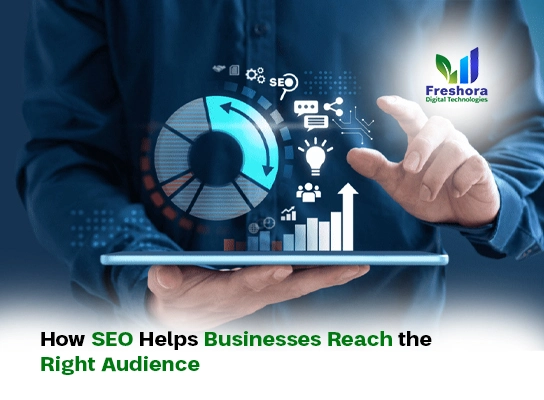
SEO becomes significantly more valuable when the objective shifts from attracting more visitors to attracting the right visitors. By understanding what people search for, why they search, where they are in the buying journey, and what information influences their decisions, businesses can build a more precise organic acquisition system. The result is a website that reaches audiences with genuine relevance instead of competing for visibility through broad, untargeted traffic.
SEO for Targeted Audience Reach helps businesses connect with people who are already searching for their products, services, solutions, or information. It uses search intent, audience research, content mapping, website optimization, local relevance, and conversion tracking to align what a business offers with what its potential customers are actively looking for.
SEO can attract users based on specific needs rather than relying only on broad demographic targeting.
Search queries provide valuable clues about problems, priorities, questions, and purchase intent.
Audience targeting should happen at the content-planning stage, not only after traffic reaches the website.
Google recommends creating helpful, reliable, people-first content for an identifiable audience rather than producing content primarily to gain search traffic.
Google Analytics can distinguish organic acquisition and connect it with events, key events, leads, and revenue-related measurements.
The strongest SEO strategy aligns audience need → search intent → content → landing page → conversion.
A website may receive thousands of visitors and still generate disappointing business results if those visitors are not the people the company can actually serve. SEO for Targeted Audience Reach takes a different approach by identifying the searches that signal genuine relevance and building content and landing pages around those needs, allowing businesses to attract a more qualified audience while making their organic visibility more commercially meaningful.
Traffic is an output, not necessarily an outcome.
Consider two websites:
|
Website |
Monthly Organic Visitors |
Qualified Enquiries |
|
Website A |
10,000 |
35 |
|
Website B |
2,800 |
110 |
Website A wins on traffic volume, but Website B may be significantly more valuable to the business.
This is why audience quality matters.
A strong SEO strategy asks:
Are visitors searching for something the business actually provides?
Are they located in the relevant service area?
Are they researching, comparing, or ready to act?
Does the landing page answer their specific need?
Do they take a meaningful business action?
The goal is not to maximize visitors indiscriminately. It is to increase the proportion of visitors who matter.
Unlike many traditional marketing channels, search often captures an expressed need.
Someone typing:
“best office cleaning company”
has a different intent from someone searching:
“how to clean an office desk.”
Similarly:
suggests a different stage of decision-making from:
“what does an SEO agency do?”
This difference creates the foundation for Search Intent Optimization.
A useful four-stage model is:
The user is trying to understand a challenge.
The user wants explanations, methods, or guidance.
The user is comparing solutions, providers, approaches, or costs.
The user is ready to enquire, purchase, book, or contact a business.
The content, page format, and call to action should change according to the intent.
A fresh way to approach targeted SEO is to build an Audience-Intent Match Map.
For every important search topic, identify five elements:
Who is searching?
What problem are they trying to solve?
What information do they expect?
What objection may prevent action?
What should they do next?
This moves keyword research beyond spreadsheets.
For example, a user searching for a local service may care about location, availability, credibility, pricing, process, response time, and proof of previous work. A page addressing only the keyword may miss the actual decision factors.
A page addressing the complete intent has a much stronger chance of being useful.
Google Analytics provides specific acquisition dimensions that help businesses understand where users originate and how they behave. Organic users can be identified through search acquisition data, while events, key events, and revenue can be evaluated alongside acquisition information.
Google's current Analytics documentation also includes reporting for new leads, qualified leads, converted leads, and user key-event rate, allowing businesses to move beyond basic traffic measurement.
That creates an important measurement shift:
Search visibility → Relevant visitor → Engaged user → Lead → Qualified lead → Customer
The further a business can connect SEO data along this chain, the better it can determine whether its audience targeting is working.
Traditional keyword research can produce hundreds or thousands of terms.
But not every term deserves a page.
A more selective process groups searches according to:
|
Audience Signal |
SEO Decision |
|
High commercial intent |
Prioritize service/product page |
|
Strong informational need |
Create educational resource |
|
Comparison behaviour |
Build evaluation content |
|
Local intent |
Develop genuine local relevance |
|
Existing customer question |
Create support/retention content |
|
Emerging search language |
Monitor and test content |
This creates Targeted SEO Strategies that reflect actual customer journeys.
Instead of publishing blogs randomly, businesses can build an Audience Ladder with four levels.
Create useful content around problems and questions faced by the target audience.
Provide deeper explanations, practical guidance, examples, and decision-making information.
Help visitors determine whether a product or service is suitable for their particular situation.
Connect qualified visitors to a relevant service page, enquiry form, booking mechanism, consultation, or purchase pathway.
This creates a controlled journey rather than sending every searcher directly to a sales page.
Google's current guidance emphasizes that content should be created primarily for people, demonstrate original value, and serve an existing or intended audience. It specifically encourages publishers to consider whether readers will leave satisfied and whether the content demonstrates first-hand expertise.
This is particularly important for Audience-Focused Search Optimization.
Generic content may technically target a keyword while failing to address the actual audience.
Strong content should instead answer:
“What would this specific customer genuinely find useful?”
That could include local examples, first-hand observations, original research, pricing considerations, practical checklists, industry-specific explanations, or real implementation lessons.
SEO can support customer acquisition when the entire journey is designed intentionally.
A practical pathway looks like:
Search Query → Relevant Result → Intent-Matched Page → Trust Signal → Clear Value Proposition → CTA → Lead
Each stage has a job.
If the search result is relevant but the landing page is generic, the journey breaks.
If the page is useful but lacks credibility, trust becomes the barrier.
If the visitor is convinced but the contact process is difficult, conversion friction appears.
Therefore, SEO for Customer Acquisition should involve both search optimization and conversion thinking.
The right audience is not necessarily the largest audience.
It is the audience that matches the business's:
Product or service.
Geographic availability.
Price range.
Expertise.
Customer profile.
Business capacity.
Commercial objectives.
For instance, a premium B2B service provider may gain little from ranking for a broad beginner-level query that attracts students and casual researchers.
A smaller query with strong commercial intent may deliver considerably greater business value.
This is where SEO becomes a qualification mechanism, not simply a traffic-generation mechanism.
Local SEO requires more than adding “Trichy” to titles and paragraphs.
For a business serving Trichy, the audience strategy can consider:
Which services have genuine local demand.
What customers ask before contacting the business.
Which areas the business actually serves.
What local concerns influence purchasing decisions.
Which pages generate enquiries from local visitors.
How Google Business Profile activity complements website visibility.
Whether mobile users can contact the business quickly.
For businesses evaluating SEO Services in Trichy, the quality of the audience strategy should therefore matter as much as the number of keywords being targeted.
At Freshora Digital Technologies, this approach can be implemented through an Audience → Intent → Content → Conversion workflow.
The process begins by understanding the business's ideal customers, services, locations, competitive environment, and existing search performance. Search terms are then grouped by intent instead of treated as an undifferentiated keyword list. Content and landing pages are mapped to those intent groups, while website navigation and conversion paths are aligned with the visitor's next likely decision.
Performance is then evaluated using organic acquisition, engagement, leads, and other meaningful business events rather than traffic volume alone. Google Analytics supports this type of cross-channel and organic measurement through acquisition and conversion reporting.
Large search volume does not guarantee commercial relevance.
Multiple similar pages can create unnecessary duplication instead of better coverage.
Customer questions can reveal valuable content opportunities that keyword tools may not surface.
Trying to appeal to every possible visitor often produces vague content.
A traffic increase is not automatically an acquisition improvement.
Google's AI experiences increasingly support longer, more specific searches and follow-up questions, making unique and satisfying content increasingly important.
Define the customer before defining the keyword target.
Separate informational and commercial search intent.
Use actual sales and customer-service questions as content inputs.
Build landing pages around audience problems, not keyword variations.
Create supporting content around important commercial topics.
Track qualified leads rather than relying only on sessions.
Review which queries attract visitors who actually engage with the business.
Use local context only where it adds genuine value.
Refresh content when audience needs or search behaviour materially changes.
The traffic may include students, job seekers, business owners, researchers, and agencies looking for information.
Instead of targeting the broad term alone, the business could create an audience-intent structure around:
Business owners → digital marketing for local businesses
Now each audience receives a more relevant entry point.
The objective is no longer simply to rank for “digital marketing.” It is to connect the right searcher with the right solution at the right stage.
Effective SEO is about audience relevance, not traffic volume alone.
Search intent reveals where users are in their decision-making journey.
Audience research should influence keyword selection, content, landing pages, and conversion paths.
The Audience Ladder provides a structured way to move visitors from discovery to action.
Local SEO should reflect genuine local customer needs.
Organic acquisition should be measured through meaningful actions and lead quality.
People-first, original content remains central to Google's current search guidance.
SEO for Targeted Audience Reach works best when businesses stop asking only how to attract more visitors and start asking which visitors are most valuable to them. By connecting audience research, search intent, useful content, local relevance, landing-page experience, and conversion measurement, SEO can become a precise customer-acquisition channel that reaches people with genuine needs rather than simply increasing website traffic.

Zero-Click Searches: Understanding Visibility When Users Stay on Google Zero-click searches occur w... Read More
In the vibrant city of Tiruchirappalli, where culture and tradition meet, photography studios often... Read More
Blog Summary: In the competitive digital landscape of Trichy, your website's visibility is the found... Read More
Our expert will call you shortly to understand your needs and help grow your business.
Get exclusive digital marketing tips, SEO insights, web & app updates, and job opportunities delivered straight to your inbox.
Join our WhatsApp channel for instant digital marketing tips, SEO insights, web & app updates, and latest job opportunities.
Join NowFreshora Digital Technologies proudly serves businesses across Tiruchirappalli (Trichy), including Cantonment, Puthur, Thillai Nagar, Palakarai, Subramaniyapuram, Mela Chinthamani, Woraiyur, KK Nagar, Karumandapam, Crawford, Edamalaipatti Pudur (EMP), Kattur, Airport Area, Ariyamangalam, Panjappur, Thuvakudi, Tiruverumbur, BHEL Township, Srirangam, Thiruvanaikaval, Samayapuram, No.1 Tollgate, Central Bus Stand Area, and Chathiram Bus Stand Area.
We also serve clients across Tamil Nadu, India, and globally in Singapore, the UAE, Saudi Arabia, Canada, Australia, the United Kingdom, and the United States, delivering innovative Website Development, Mobile App Development, Software Development, SEO, Google Business Profile Management, and Digital Marketing solutions that help businesses grow and succeed in the digital world.

