
Contact our team for professional guidance and solutions.
Choosing ERP Software in Trichy for Business Efficiency should start with your business problems, not a software feature list. If employees spend too much time moving information between departments, preparing reports, checking stock or following up on approvals, the right ERP can make those processes more structured. However, not every business needs the same solution. The best choice depends on your workflow, industry, existing software, number of users, automation needs, budget and future plans.
A business rarely becomes inefficient overnight. More often, small workarounds accumulate over time: sales teams maintain their own spreadsheets, purchase requests move through messaging apps, accounts receive information late and managers wait for different employees to prepare reports. Each workaround may seem manageable on its own, but together they create delays and make business information harder to control. This is where ERP becomes worth considering. However, choosing an ERP should not begin with a demonstration of dozens of features. It should begin with a closer look at how your business actually works today, where employees lose time and which processes need better coordination. For businesses evaluating ERP Software Solutions in Trichy, this approach can help identify a solution that improves efficiency without introducing unnecessary complexity or cost.
Before investing in ERP, determine whether the problem is actually the software.
Suppose a sales executive takes ten minutes to prepare every quotation. That does not automatically mean the company needs ERP.
The underlying problem could be:
Missing product information
An unclear pricing process
Repeated approval
Poorly organised customer data
Lack of a standard quotation format
Similarly, if management spends hours preparing reports, the problem could be disconnected data rather than a lack of reporting features.
This distinction matters because software cannot automatically fix a poorly designed business process.
Start by asking:
Where exactly are employees losing time?
Once those points are identified, you can determine whether ERP, integration, automation or process redesign is the appropriate solution.
If customer, product or transaction details are entered into multiple applications, there is a higher chance of inconsistency.
If sales must call the warehouse to check stock or accounts must repeatedly request transaction information, information flow may be the problem.
When managers need several spreadsheets combined manually before they can understand business performance, reporting can become a productivity drain.
Purchase requests, discounts, expenses or leave approvals should have a visible status. If employees depend on messages and reminders, the process may need restructuring.
A workflow that works for ten employees may become difficult when the organisation reaches fifty employees, multiple branches or significantly higher transaction volumes.
These signs do not automatically mean that a full ERP is necessary. They indicate that the current operating model deserves closer examination.
One of the most useful steps before selecting an ERP is to map your important processes.
Take sales as an example:
Enquiry → Quotation → Approval → Order → Stock Check → Invoice → Delivery
Now identify:
Who performs each step?
Where is the information stored?
How many times is it entered?
Which step requires approval?
Where do delays normally occur?
Which department needs the information next?
Which activities are repetitive?
Do the same for:
Purchasing
Finance
HR
Customer Management
This creates a requirements document based on actual operations rather than assumptions.
Keep: Processes that already work well.
Improve: Processes that create delays or confusion.
Automate: Repetitive activities that follow predictable rules.
Integrate: Processes that already work in another application but need information exchange.
This framework can prevent unnecessary ERP purchases.
The right solution depends on what your organisation is trying to improve.
Focus on:
Stock visibility
Purchase management
Goods receipt
Sales allocation
Reorder requirements
Warehouse movement
Focus on:
Customer records
Quotations
Order processing
Pricing
Invoicing
Follow-ups
Look at:
Transaction records
Receivables
Payables
Expense management
Financial reporting
Integration with operational systems
Consider:
Centralised information
Branch-level permissions
Consolidated reporting
Location-specific transactions
Shared customer and product data
This is more useful than asking which ERP is “best” in general.
The better question is:
Which ERP approach solves our most important operational problems with the least unnecessary complexity?
ERP for Business Process Automation is most valuable when a task follows clear, repeatable rules.
For example:
Purchase Request → Manager Approval → Purchase Order
The system can automatically send the request to the appropriate person and update its status after approval.
Other suitable automation areas can include:
Approval notifications
Reorder alerts
Task assignments
Invoice creation
Payment reminders
Scheduled reports
Status updates
But not every activity should be automated.
A purchase request may be routed automatically, while the manager should still decide whether the purchase is appropriate.
The goal is less administrative friction, not less human decision-making.
This is one of the most overlooked ERP decisions.
Imagine a business already has accounting software that its finance team understands well.
The company also has:
The answer does not necessarily need to be:
Replace Everything → Install New ERP
An alternative could be:
Website → CRM → ERP → Existing Accounting System → Payment
If an existing application performs its function effectively, integration may be more practical than replacement.
Before replacing a system, ask:
Does it actually cause the problem?
Can the ERP integrate with it?
Would replacement disrupt employees?
What would migration cost?
Would the new system provide enough additional value?
This can significantly improve the quality of an ERP investment decision.
ERP Software for Business Efficiency should create measurable improvements in everyday work.
Consider a purchase process.
The status may be unclear.
The stages become easier to monitor.
The same principle applies to reporting.
The important question is not whether the ERP has a dashboard.
The important question is:
Does the dashboard reduce the effort required to understand the business?
That is a much better measure of efficiency.
Businesses searching for Business ERP Solutions in Trichy should consider local requirements without assuming that every local business needs the same system.
A manufacturing company may need production and inventory capabilities.
A distributor may prioritise warehouse and order management.
A retailer may need billing and stock coordination.
A service company may focus on projects, customers and invoicing.
ERP success depends heavily on configuration, data migration, testing and training.
Employees need somewhere to turn when a workflow stops working or a new requirement appears.
The ERP should fit into the organisation's current technology environment where practical.
Think about realistic growth:
More users
More products
More branches
More transactions
New business functions
The system should be able to accommodate reasonable growth without requiring a complete rebuild.
Avoid comparing ERP proposals based only on the headline price.
A realistic comparison should include:
Software Cost
Implementation
Customisation
Integration
Data Migration
Training
Infrastructure
Support
Maintenance
Future Upgrades
For example, Platform A may have a lower initial price but require extensive custom development. Platform B may cost more initially but support most requirements without significant modification.
The better question is:
Which option provides the best long-term value for our actual requirements?
When evaluating ERP Implementation Services in Trichy, ask practical questions instead of only requesting a product demonstration.
How will you understand our existing workflow?
How will you identify process bottlenecks?
Which requirements do you think should not be automated?
Which requirements work through standard configuration?
Which requirements need customisation?
What integrations are available?
How are user permissions handled?
How will data be cleaned and migrated?
How will testing be conducted?
What training will employees receive?
What happens during go-live?
How are updates handled?
Who handles technical issues?
What support is included?
How are future enhancements managed?
A provider that asks detailed questions about your business before recommending software is generally demonstrating a more thoughtful implementation approach.
Businesses in Trichy exploring ERP and connected business systems can consider Freshora Digital Technologies when evaluating technology solutions for improving business workflows. Before approaching a provider, prepare your current processes, major operational problems, user requirements, existing software, integration needs and expected outcomes so the proposed solution can be assessed against genuine business requirements.
More functionality does not automatically mean a better fit.
Two businesses in the same industry can have completely different workflows.
Custom development should solve genuine requirements, not reproduce every old process exactly.
Replacing systems that already work can create unnecessary disruption.
Without understanding current workflows, it is difficult to know what the ERP actually needs to accomplish.
The system needs to remain useful after launch through support, maintenance and optimisation.
Before requesting proposals, make sure your business can answer:
What are our biggest operational problems?
Which processes consume the most employee time?
Which information is entered repeatedly?
Which departments need shared information?
Which activities should be automated?
Which existing systems should remain?
Which systems need integration?
How many users need access?
What permissions are required?
What reports does management actually need?
What data needs cleaning?
What level of customisation is genuinely necessary?
What budget is available for implementation and ongoing support?
How will we measure improvement?
The clearer these answers are, the easier it becomes to compare ERP providers objectively.
ERP implementation should have measurable objectives.
Track improvements in:
Time spent on key processes
Approval turnaround
Duplicate data entry
Report preparation time
Inventory accuracy
Manual workarounds
User adoption
Customer response time
Information availability
For example, if a report previously took four hours to prepare, establish whether the new system reduces that effort.
If employees previously entered customer information in three places, measure whether duplicate entry has actually been eliminated.
This turns ERP from a technology purchase into a measurable efficiency project.
Choosing ERP Software in Trichy for Business Efficiency should be approached as a business improvement decision rather than a search for the software with the biggest feature list. The strongest starting point is to understand where your employees lose time, where information is duplicated, which processes depend on manual follow-ups and which existing systems already work well. From there, businesses can determine whether they need a full ERP, integration, automation or a combination of solutions. When comparing providers, process understanding, implementation capability, usability, integration, scalability, support and total cost should receive as much attention as the software itself. For businesses exploring ERP Software Solutions in Trichy, the most valuable outcome is not simply having a new platform; it is creating a more organised way to move information, complete work and measure performance. A carefully selected and properly implemented ERP can reduce operational friction, improve visibility and give growing businesses a stronger foundation for efficient day-to-day operations.



Introduction Not every Dubai business needs custom software. A ready-made CRM, accounting system, E... Read More

Introduction Business software has become part of almost every day-to-day operation. A single platf... Read More
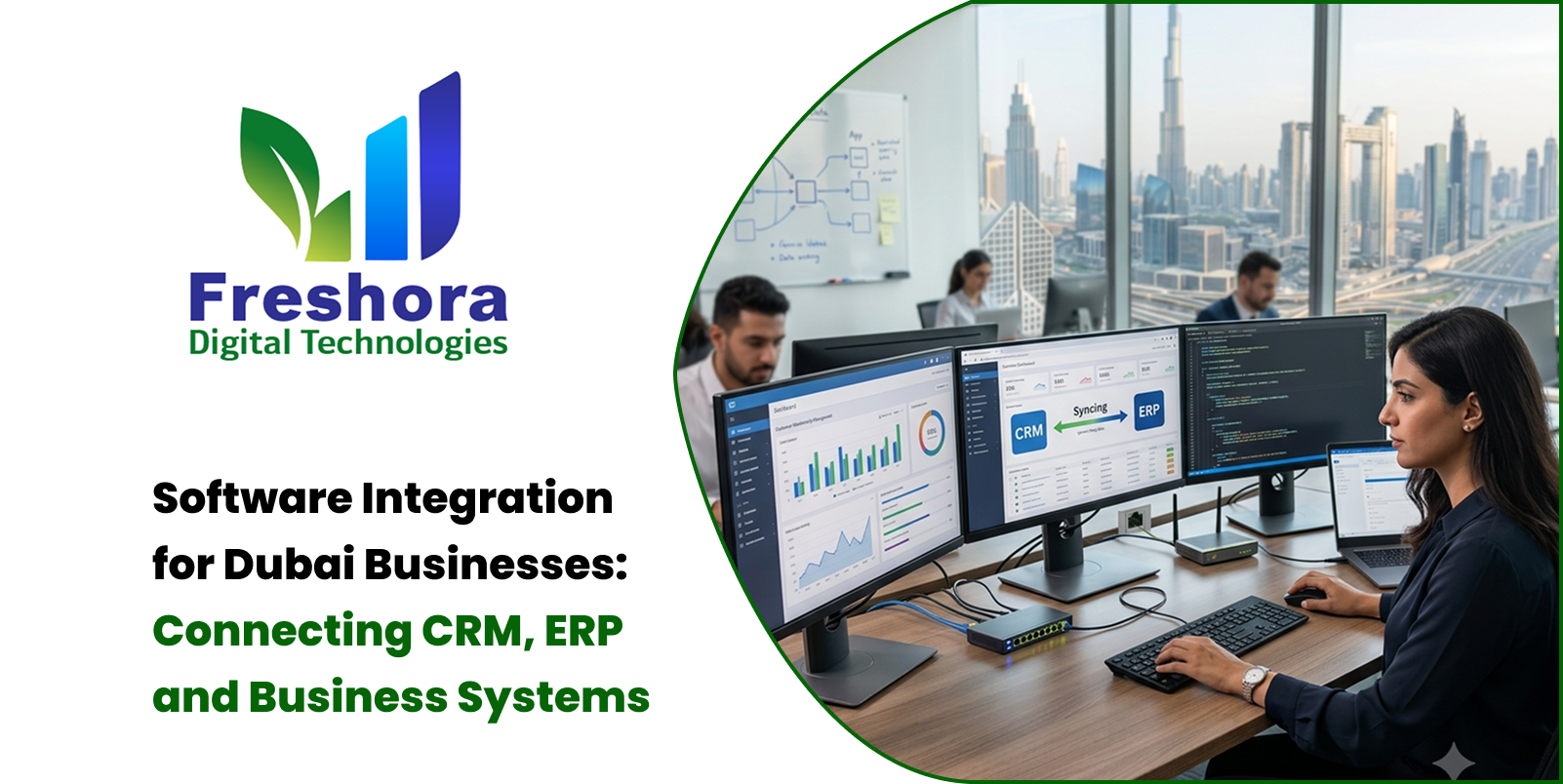
A growing business rarely operates from a single software system. A website may capture enquiries, a... Read More
Our expert will call you shortly to understand your needs and help grow your business.
Get exclusive digital marketing tips, SEO insights, web & app updates, and job opportunities delivered straight to your inbox.
Join our WhatsApp channel for instant digital marketing tips, SEO insights, web & app updates, and latest job opportunities.
Join NowFreshora Digital Technologies proudly serves businesses across Tiruchirappalli (Trichy), including Cantonment, Puthur, Thillai Nagar, Palakarai, Subramaniyapuram, Mela Chinthamani, Woraiyur, KK Nagar, Karumandapam, Crawford, Edamalaipatti Pudur (EMP), Kattur, Airport Area, Ariyamangalam, Panjappur, Thuvakudi, Tiruverumbur, BHEL Township, Srirangam, Thiruvanaikaval, Samayapuram, No.1 Tollgate, Central Bus Stand Area, and Chathiram Bus Stand Area.
We also serve clients across Tamil Nadu, India, and globally in Singapore, the UAE, Saudi Arabia, Canada, Australia, the United Kingdom, and the United States, delivering innovative Website Development, Mobile App Development, Software Development, SEO, Google Business Profile Management, and Digital Marketing solutions that help businesses grow and succeed in the digital world.

