Contact our team for professional guidance and solutions.
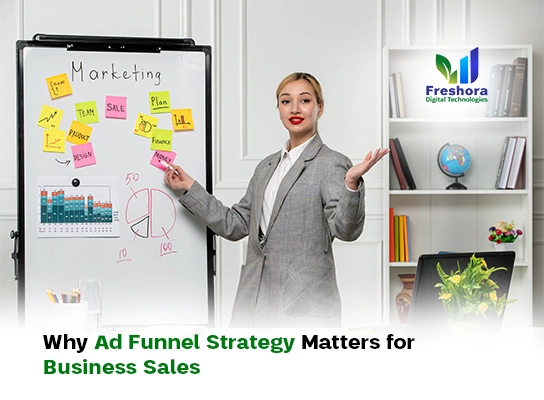
Running paid advertisements without a structured customer journey can result in wasted budgets and low conversions. Modern businesses need an Ad Funnel Strategy that guides potential customers from initial awareness to final purchase through stage-specific messaging, audience targeting, lead nurturing, retargeting, and performance optimization.
Instead of expecting one advertisement to generate immediate sales, businesses can build a complete Sales Funnel Marketing system supported by a strong Lead Generation Funnel, a data-driven Paid Advertising Strategy, and continuous Conversion Funnel Optimization. This guide explains how a structured advertising funnel can improve customer acquisition, reduce advertising waste, and support sustainable business growth.
An Ad Funnel Strategy is a stage-based advertising approach that delivers the right message to the right audience at the right point in the buying journey. It combines awareness campaigns, lead generation, nurturing, retargeting, and conversion-focused advertising. By aligning campaigns with customer intent and measuring performance across the full funnel, businesses can improve lead quality, conversion opportunities, and advertising efficiency.
Structured funnels can be more effective than relying on a single advertisement.
Customer intent changes throughout the buying journey.
Stage-specific messaging can improve lead relevance and engagement.
Retargeting can reconnect with prospects who are not ready to purchase initially.
Landing-page and campaign optimization can reduce conversion friction.
Full-funnel measurement provides a clearer view of advertising performance.
Consistent communication can strengthen customer trust.
A well-managed funnel can support scalable business growth.
Many businesses invest in paid advertising expecting immediate sales, yet campaigns can generate clicks without producing meaningful conversions. Customers often need time to understand a problem, research solutions, compare alternatives, evaluate trust, and decide whether a business is right for them.
A structured Ad Funnel Strategy aligns advertising with these different stages. Instead of treating every visitor the same way, businesses can use awareness campaigns for new audiences, educational content for interested prospects, lead-generation offers for potential customers, and remarketing or conversion campaigns for people showing stronger purchase intent.
This approach helps businesses create a more relevant customer journey. It also makes it easier to identify where prospects leave the funnel and where improvements are needed.
Business owners commonly ask:
Why doesn't one advertisement generate consistent sales?
What is an Ad Funnel Strategy?
How does funnel marketing improve advertising performance?
Why is retargeting important?
How can businesses reduce advertising waste while increasing conversions?
The answer begins with understanding customer intent and building campaigns around the complete buying journey.
Note: Advertising benchmarks vary by industry, platform, audience, offer, geography, and campaign objective. Performance statistics should therefore be evaluated against reliable original sources and the business's own historical data rather than treated as universal benchmarks.
An Ad Funnel Strategy is a structured advertising system that guides potential customers through multiple decision-making stages before and after purchase.
A practical funnel can include:
Brand awareness.
Audience engagement.
Customer nurturing.
Purchase consideration.
Conversion optimization.
Customer retention.
Referral generation.
Each stage has a different purpose. A person discovering a brand for the first time may need educational content, while an existing prospect may need a product demonstration, case study, consultation, or stronger purchase offer.
Customer behaviour is often research-driven. Before making a purchasing decision, prospects may:
Compare competitors.
Read online reviews.
Visit multiple websites.
Download resources.
Watch demonstration videos.
Ask questions.
Request quotations.
Evaluate trust.
Funnel-based advertising supports these different behaviours instead of forcing every visitor toward an immediate purchase.
For example, a visitor who has never heard of a business may respond better to educational content, while someone who has already visited a pricing page may be more suitable for a remarketing campaign with a clear conversion-focused message.
Sales Funnel Marketing focuses on moving prospects progressively toward purchase instead of expecting an immediate conversion.
A customer journey may include:
Awareness
Interest
Consideration
Evaluation
Decision
Purchase
Advocacy
Customer intent also changes throughout this journey.
The customer recognizes a need or problem.
Advertising focus: Educational content, industry insights, and problem awareness.
The customer starts exploring possible solutions.
Advertising focus: Guides, videos, comparisons, and solution-focused content.
The customer compares providers, products, features, pricing, or reviews.
Advertising focus: Case studies, testimonials, product information, and differentiators.
The customer shows stronger buying intent.
Advertising focus: Consultations, demonstrations, offers, pricing information, and strong calls to action.
The customer evaluates the experience and may become a repeat customer or advocate.
Advertising focus: Onboarding, loyalty communication, relevant recommendations, referrals, and customer engagement.
Matching advertising to intent makes the funnel more relevant and reduces the risk of sending the same message to every audience.
A Lead Generation Funnel captures interested prospects before attempting to convert them into customers.
Common lead-generation methods include:
Free consultations.
Downloadable guides.
Webinar registrations.
Product demonstrations.
Contact forms.
Landing pages.
Newsletter subscriptions.
Free assessments.
Calculators and tools.
| Business Type | Lead Generation Offer |
|---|---|
| IT company | Free cybersecurity assessment |
| Digital marketing agency | Free SEO audit |
| Consultant | Free strategy consultation |
| Real estate company | Property consultation |
| B2B service provider | Free business requirements assessment |
| Training company | Free course or learning resource |
The offer should match the audience's needs and the stage of the funnel. A useful lead-generation offer gives prospects a reason to provide their details instead of simply asking them to “Contact Us.”
A successful Ad Funnel Strategy should connect advertising activity with measurable business outcomes.
Customers must first recognize a business before they can seriously consider it.
Awareness campaigns can focus on:
Brand storytelling.
Educational videos.
Industry insights.
Customer pain points.
Product introductions.
Social proof.
Thought leadership.
High-reach advertising.
Example: A digital marketing company can run educational ads explaining common SEO problems before promoting a paid service.
Not every visitor is ready to buy immediately.
Lead capture methods include:
Landing pages.
Free consultations.
Downloadable guides.
Product demonstrations.
Webinar registrations.
Cost calculators.
Contact forms.
Newsletter subscriptions.
Example: After an awareness campaign about cybersecurity risks, an IT company can offer a free security assessment to interested visitors.
Prospects may need additional information and trust before making a decision.
Lead nurturing can include:
Educational emails.
Customer success stories.
Product comparisons.
FAQ content.
Case studies.
Industry reports.
Video demonstrations.
Remarketing campaigns.
The message should become more specific as purchase intent increases.
Conversion-focused campaigns should make the next step clear and easy.
Optimization can include:
Landing-page testing.
CTA improvements.
Audience refinement.
Ad creative testing.
Offer optimization.
Page-speed improvements.
Conversion tracking.
Behaviour analysis.
The funnel should not end at the first purchase.
Businesses can continue the relationship through:
Customer onboarding.
Helpful follow-up communication.
Loyalty programs.
Relevant product recommendations.
Feedback requests.
Referral programs.
Customer communities.
Retention and advocacy can increase the long-term value of acquired customers.
A professional Paid Advertising Strategy aligns advertising budgets with business goals and customer intent.
A practical strategy includes:
Understand customer needs, behaviours, demographics where relevant, and purchase intent.
Choose advertising platforms based on where the target audience is active and which platform supports the campaign objective.
Define whether the campaign is intended to generate awareness, traffic, leads, sales, or another measurable outcome.
Create headlines, images, videos, offers, and calls to action that match the audience and funnel stage.
Distribute spending according to funnel needs, campaign performance, and business objectives rather than assuming every stage requires the same budget.
Reconnect with people who have previously interacted with a business, such as website visitors, video viewers, or previous leads, where appropriate and privacy-compliantly.
Review campaign data regularly and adjust audiences, creatives, offers, landing pages, and budgets based on performance.
Conversion Funnel Optimization improves the customer journey by identifying and reducing barriers between the first interaction and the desired conversion.
Important optimization areas include:
Landing-page improvements.
Audience segmentation.
A/B testing.
Conversion tracking.
Ad creative refinement.
Offer optimization.
Page-speed improvements.
Customer feedback.
Behaviour analysis.
Businesses can lose potential customers at different points in the journey.
Common leakage points include:
Weak landing pages.
Slow-loading websites.
Poor audience targeting.
Complex forms.
Weak follow-up processes.
Generic messaging.
Poor mobile experiences.
Lack of trust signals.
Identifying these points helps businesses decide where optimization efforts should be focused.
Not every lead has the same purchase potential.
Businesses can qualify prospects using relevant factors such as:
Budget fit.
Purchase urgency.
Decision-making authority.
Industry relevance.
Previous engagement.
Website activity.
Product or service interest.
Qualification helps sales teams prioritize leads and prevents advertising-generated leads from being treated as equally valuable when their intent differs.
Reducing customer acquisition cost can improve advertising profitability, but the lowest possible cost is not always the best objective. Businesses should consider lead quality, conversion rate, revenue, and customer lifetime value alongside acquisition cost.
Optimization strategies include:
Better audience segmentation.
Higher-quality creatives.
Improved landing pages.
Stronger remarketing.
Conversion tracking.
Continuous testing.
Campaign refinement.
Better lead qualification.
The goal is to acquire valuable customers efficiently rather than simply generating the cheapest clicks or leads.
Businesses should evaluate the complete funnel instead of judging campaigns only by impressions or clicks.
Important KPIs include:
Reach.
Click-through rate.
Cost per click.
Cost per lead.
Lead qualification rate.
Conversion rate.
Customer acquisition cost.
Return on ad spend.
Revenue generated.
Customer lifetime value.
A useful measurement process connects advertising activity to actual business outcomes. For example, a campaign with a higher cost per lead may still be more valuable if it produces better-qualified prospects and more revenue.
| Direct Advertising | Ad Funnel Strategy |
|---|---|
| Immediate sales focus | Customer journey focus |
| One advertisement or limited campaign sequence | Multi-stage campaigns |
| Limited personalization | Stage-specific messaging |
| Basic audience targeting | Behaviour-based audience segmentation |
| Focus on individual campaign results | Full-funnel performance measurement |
| Less emphasis on nurturing | Progressive lead nurturing |
| Higher risk of losing undecided visitors | Retargeting and follow-up opportunities |
| Short-term campaign focus | Long-term customer journey |
| Can prioritize clicks or immediate conversions | Connects acquisition with revenue and retention |
A structured Ad Funnel Strategy does not mean direct-response advertising is ineffective. Instead, it provides a broader system in which direct conversion campaigns can work alongside awareness, lead generation, nurturing, and retention.
Customers may need education and trust before making a purchase decision. Not every audience should receive a hard sales message immediately.
Some businesses focus only on awareness and final conversion while neglecting prospects who need more information before buying.
Different audiences and campaign objectives may require different landing-page experiences.
Clicks are useful indicators, but business performance also depends on lead quality, conversions, revenue, acquisition cost, and customer value.
Advertising performance can change as audiences, creatives, offers, competition, and platforms change. Continuous testing and refinement are therefore important.
Advertising funnels are increasingly influenced by automation, artificial intelligence, predictive analytics, and privacy-conscious data practices.
Emerging areas include:
AI-powered audience analysis.
Predictive customer-intent analysis.
Dynamic creative optimization.
Automated budget allocation.
Real-time funnel personalization.
AI-assisted conversion forecasting.
Omnichannel funnel integration.
Predictive lead scoring.
Behaviour-based ad sequencing.
Intelligent revenue attribution.
Businesses should adopt these technologies according to their objectives, available data, privacy requirements, and actual performance rather than using AI simply because it is a trend.
At Freshora Digital Technologies, we build advertising funnel systems that help businesses attract qualified audiences, nurture prospects, improve conversions, and measure advertising performance.
Our approach can include:
Designing customized Ad Funnel Strategy models aligned with measurable business objectives.
Developing Sales Funnel Marketing systems that guide prospects through relevant buying stages.
Creating Lead Generation Funnel campaigns using landing pages, valuable offers, CRM integration, automation, and remarketing.
Delivering Paid Advertising Strategy solutions through audience segmentation, creative testing, campaign optimization, and performance analysis.
Providing Conversion Funnel Optimization together with integrated Digital Marketing Services in Trichy, including SEO, performance marketing, analytics, automation, content marketing, and CRM integration.
Our objective is to help businesses build measurable advertising systems that generate qualified leads, improve conversions, and support sustainable revenue growth.
Businesses in Trichy can use funnel-based advertising to connect local audiences with relevant products and services.
For example, a Trichy-based educational institution can use awareness campaigns to introduce a course, lead-generation ads to collect enquiries, remarketing to reconnect with interested visitors, and conversion-focused campaigns to encourage applications.
Similarly, a local service business can use educational content to build awareness, a consultation or assessment to capture leads, follow-up communication to build trust, and remarketing to encourage prospects to take the next step.
When combined with Digital Marketing Services in Trichy, an advertising funnel can connect paid campaigns with SEO, content marketing, CRM systems, analytics, automation, and conversion optimization.
Use this checklist to review your advertising funnel regularly:
Is every funnel stage clearly defined?
Are awareness campaigns generating relevant traffic?
Is the lead-generation process optimized?
Are landing pages aligned with each campaign?
Are remarketing campaigns being used appropriately?
Is customer behaviour tracked accurately?
Are lead quality and conversion rates monitored?
Are advertising costs reviewed regularly?
Are landing pages and creatives tested?
Is revenue connected to advertising performance?
Is the customer acquisition cost sustainable?
Is the strategy updated based on performance data?
Routine audits can reveal funnel leakage and opportunities for improvement.
Increasing the advertising budget before understanding the customer journey can increase waste. Establish the funnel, tracking, landing pages, and follow-up process before scaling successful campaigns.
Use different messages for people who are discovering a problem, researching solutions, comparing providers, and preparing to purchase.
A relevant landing page should match the advertisement, communicate the offer clearly, provide trust signals, and make the next action easy.
Evaluate lead quality, customer acquisition cost, conversion rate, revenue, and return on ad spend together.
Use testing and performance data to refine targeting, creatives, offers, landing pages, and follow-up processes.
A structured Ad Funnel Strategy guides prospects from awareness to conversion and retention.
Sales Funnel Marketing aligns communication with customer intent.
A strong Lead Generation Funnel captures and nurtures qualified prospects.
A data-driven Paid Advertising Strategy connects audience research, campaigns, budgets, retargeting, and optimization.
Conversion Funnel Optimization identifies and reduces friction throughout the customer journey.
Full-funnel metrics provide better insight than clicks or impressions alone.
Practical lead-generation offers can make advertising more useful and relevant.
Businesses should optimize for valuable customers rather than the cheapest clicks or leads.
Digital Marketing Services in Trichy can integrate advertising with SEO, content marketing, CRM, analytics, automation, and funnel optimization.
Successful paid advertising is not only about creating a compelling advertisement. It is about building a customer journey that moves prospects from their first interaction toward consideration, conversion, retention, and advocacy.
An effective Ad Funnel Strategy combines awareness campaigns, lead generation, nurturing, retargeting, conversion optimization, and performance measurement. Sales Funnel Marketing helps businesses adapt communication to customer intent, while a strong Lead Generation Funnel creates opportunities to nurture qualified prospects. A well-planned Paid Advertising Strategy and continuous Conversion Funnel Optimization can help businesses use advertising budgets more efficiently.
At Freshora Digital Technologies, we help businesses design advertising funnels that combine audience research, landing-page optimization, CRM integration, automation, analytics, and performance marketing. As a provider of Digital Marketing Services in Trichy, our focus is on building measurable systems that help businesses generate qualified leads, improve conversions, and support sustainable growth.
Summary: This article explains bulk email marketing Trichy, covering email campaigns, automation, le... Read More
Blog Summary Email remains one of the most effective ways for businesses to communicate directly wi... Read More
Blog Summary Business communication is no longer limited to phone calls, printed brochures, or occa... Read More
Our expert will call you shortly to understand your needs and help grow your business.
Get exclusive digital marketing tips, SEO insights, web & app updates, and job opportunities delivered straight to your inbox.
Join our WhatsApp channel for instant digital marketing tips, SEO insights, web & app updates, and latest job opportunities.
Join NowFreshora Digital Technologies proudly serves businesses across Tiruchirappalli (Trichy), including Cantonment, Puthur, Thillai Nagar, Palakarai, Subramaniyapuram, Mela Chinthamani, Woraiyur, KK Nagar, Karumandapam, Crawford, Edamalaipatti Pudur (EMP), Kattur, Airport Area, Ariyamangalam, Panjappur, Thuvakudi, Tiruverumbur, BHEL Township, Srirangam, Thiruvanaikaval, Samayapuram, No.1 Tollgate, Central Bus Stand Area, and Chathiram Bus Stand Area.
We also serve clients across Tamil Nadu, India, and globally in Singapore, the UAE, Saudi Arabia, Canada, Australia, the United Kingdom, and the United States, delivering innovative Website Development, Mobile App Development, Software Development, SEO, Google Business Profile Management, and Digital Marketing solutions that help businesses grow and succeed in the digital world.


